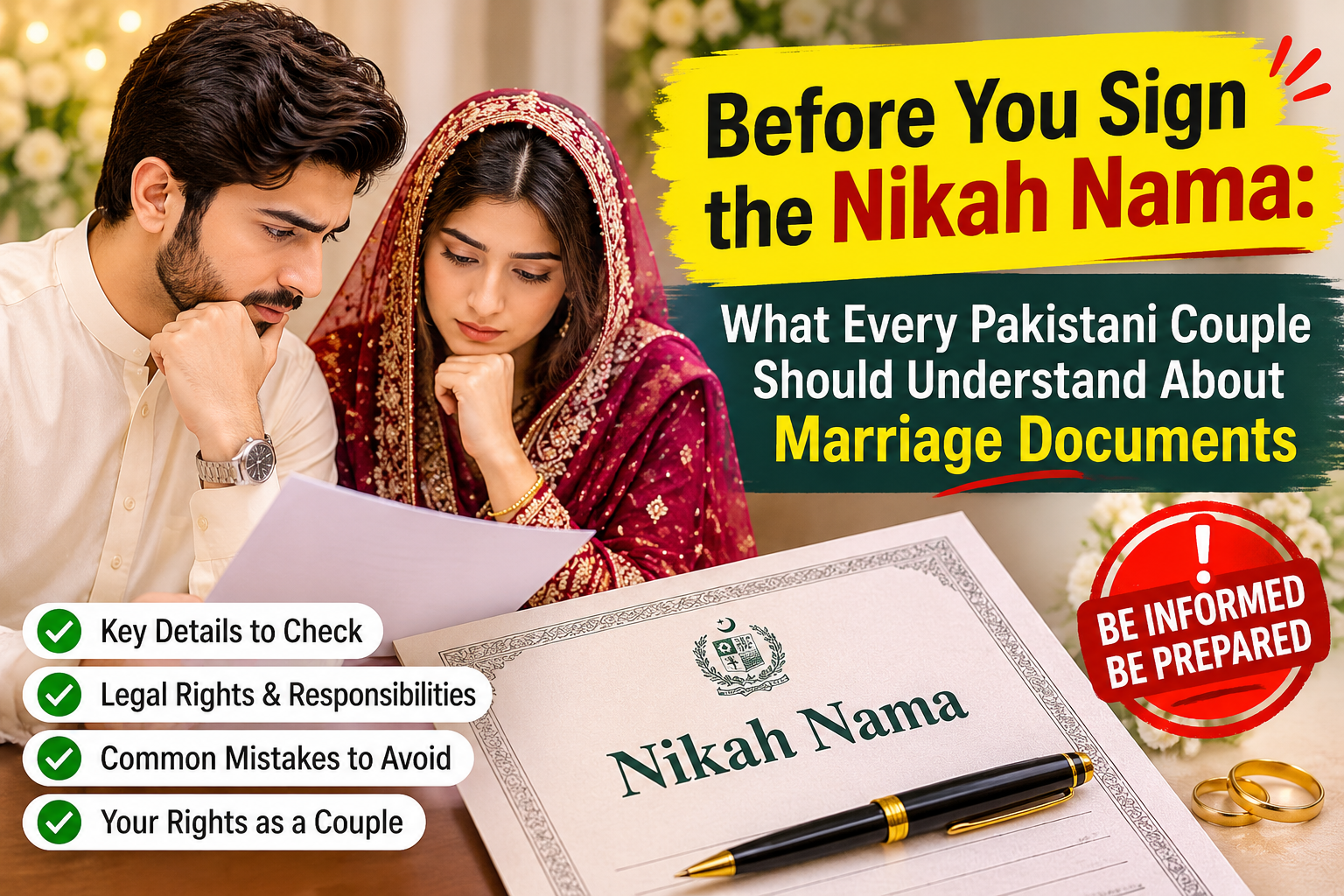
Marriage is often remembered through its most beautiful moments: the gathering of families, the exchange of promises, the prayers, and the beginning of a shared life. Yet, among all the preparations that take place before a wedding, one document deserves considerably more attention than it usually receives: the Nikah Nama.
For many couples, the signing of the Nikah Nama is treated as a routine part of the wedding ceremony. Families arrange the venue, guests gather, photographs are taken, and the marriage document is completed. However, the information recorded in this document can have lasting personal and legal significance.
The Nikah Nama is not simply a record that two people have married. It contains important information about the marriage agreement, including dower, agreed conditions, personal details, witnesses, and other relevant particulars.
Unfortunately, some individuals sign without taking sufficient time to understand what has been written, which entries have been completed, or whether the recorded information accurately reflects their understanding.
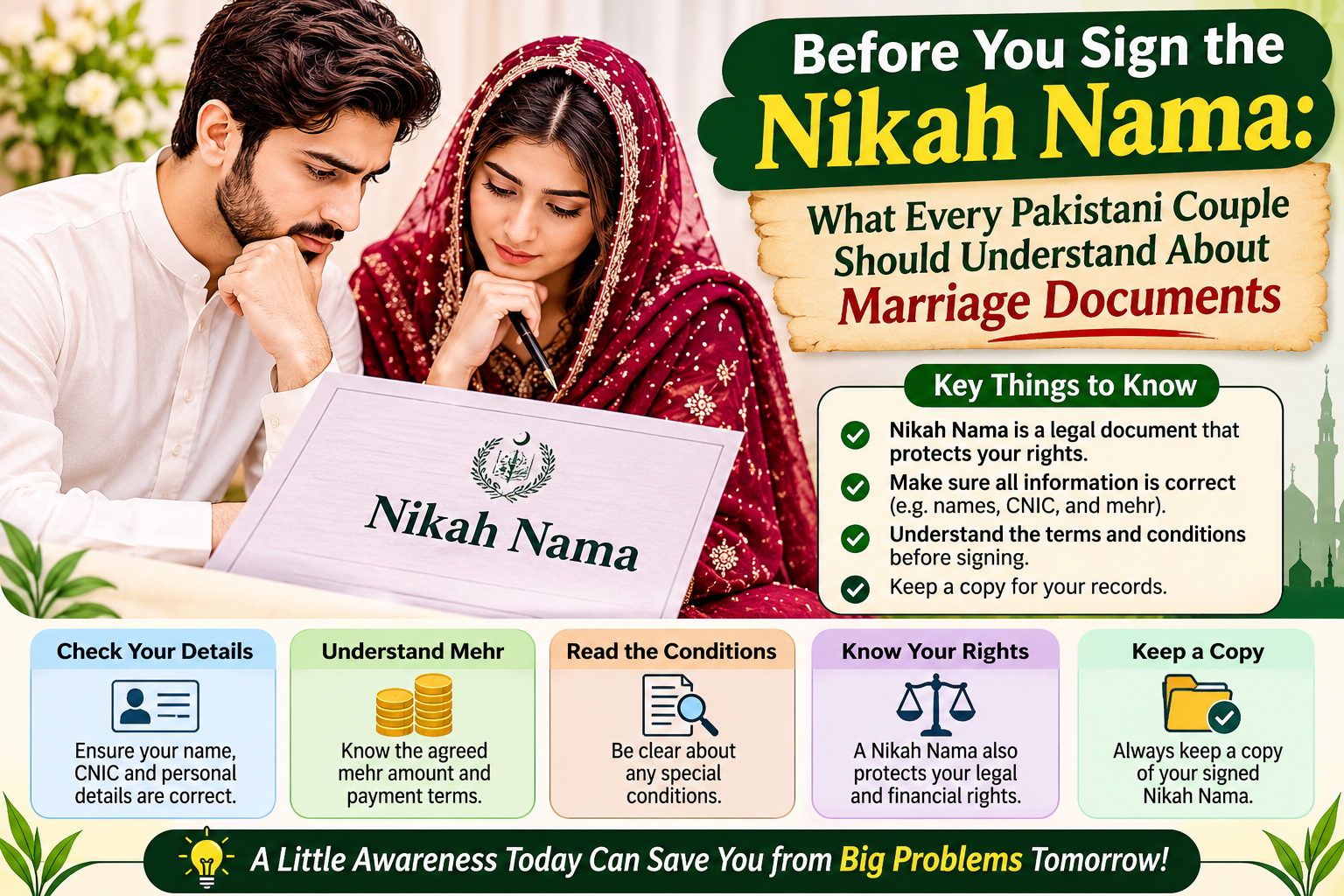
An important principle: A marriage document should represent the actual agreement between the individuals. Both parties deserve the opportunity to understand its entries, ask questions, and check that the recorded information is accurate.
This guide explains the important aspects of the Nikah Nama in Pakistan, why couples should review its entries carefully, how marriage registration works, and what documents may become important when dealing with future administrative or international requirements.
In This Article
- Understanding the Nikah Nama
- Why Every Entry Matters
- Haq Mehr and Its Payment Terms
- Understanding Special Conditions
- Delegated Divorce Rights
- Documentation Mistakes
- Marriage Registration Certificate
- Using Marriage Documents Abroad
- NADRA Family Registration Certificate
- Before Signing Checklist
- Keeping Marriage Records Safe
1. Understanding What the Nikah Nama Actually Represents
The first important step is understanding that the Nikah Nama serves a purpose beyond documenting the date of a wedding.
Under section 5 of the Muslim Family Laws Ordinance, 1961, Muslim marriages are required to be registered according to the provisions of the Ordinance. The legislation also provides for licensed Nikah Registrars and the preservation of marriage records.
You can consult the original legislation through the official Pakistan Code – Muslim Family Laws Ordinance, 1961 .
The prescribed marriage form records information about both individuals and the terms associated with their marriage.
This is important because a marriage document should not contain assumptions made by someone else. It should accurately reflect the information and agreements that the individuals understand and accept.
The purpose of reviewing the document is not to create unnecessary complications during a wedding. It is to make sure that an important agreement receives the attention it deserves.
2. Why Every Entry Deserves Proper Attention
Many people assume that the most important information in the Nikah Nama is simply the names of the bride and groom, their signatures, and the amount of Haq Mehr.
These details are important, but they are not the entire document.
The official Form II reproduced in the West Pakistan Rules under the Muslim Family Laws Ordinance contains different categories of information. These include personal particulars, witnesses, dower arrangements, special conditions, delegated rights, and marriage registration details.
The original form can be examined in the official West Pakistan Rules under the Muslim Family Laws Ordinance, 1961 .
Rather than treating the form as a collection of routine boxes, couples should understand the purpose of its different sections.
Personal information and identification
Names, ages, addresses, family details, and marital status should be recorded accurately.
Even a minor spelling mistake can create unnecessary administrative difficulties when the document is later compared with identity records.
Both individuals should review their information before signing. It is also sensible to check that the details correspond with their relevant identification documents.
Witness information
The document contains details relating to witnesses and other individuals involved in the marriage process.
Couples should ensure that the required information is correctly recorded and that the relevant signatures are obtained.
Marriage and registration details
The place and date of marriage, the person solemnizing the marriage, and its registration information are important parts of the record.
These details may become relevant when requesting copies or completing subsequent documentation.
3. Haq Mehr: Understand the Agreement, Not Just the Amount
Haq Mehr, also known as dower, is one of the most significant subjects recorded in the Nikah Nama.
Although families commonly discuss the amount before the wedding, the practical details of its payment can receive much less attention.
The prescribed form includes entries for the agreed dower amount, the portions payable promptly or deferred, any amount already paid, and property given in place of all or part of the dower.
These are meaningful distinctions.
For example, agreeing on a total dower amount is different from understanding when that amount is payable. Similarly, when property is agreed upon instead of money, its description and agreed valuation should not be left uncertain.
Important points to discuss
- What total amount or property has been mutually agreed upon?
- Is any portion payable immediately?
- Is any amount deferred?
- Has any amount already been paid?
- Is property included in the agreement?
- Does the written entry accurately reflect the actual understanding?
The discussion should be based on honesty rather than social pressure.
Haq Mehr is not merely a figure chosen to make a wedding arrangement appear impressive. It is a significant marital right that deserves an informed agreement.
For questions about the legal consequences of a particular dower arrangement, professional legal guidance is advisable.
4. Special Conditions: The Section Couples Should Discuss Carefully
One of the most important parts of the Nikah Nama concerns special conditions.
People sometimes concentrate on the visible details of a marriage arrangement while overlooking the possibility of recording additional mutually agreed terms.
The prescribed form includes a section for special conditions. This allows the parties to consider whether particular conditions should be recorded as part of their marriage agreement, subject to applicable law.
These discussions may involve matters that are personally important to the individuals.
For example, a couple may wish to discuss expectations concerning employment, education, living arrangements, or other subjects that could affect their shared life.
However, simply discussing a condition verbally is not necessarily the same as having it properly documented.
If both individuals agree on a specific condition, they should seek appropriate guidance about how it should be worded and recorded.
A vague sentence may create confusion later. A clearly written condition makes the intended agreement easier to understand.
The important point is that a marriage document should reflect what the individuals actually understand and agree to, rather than what other people assume they want.
5. Delegated Divorce Rights and Other Important Legal Provisions
The Nikah Nama also contains provisions concerning delegated divorce rights and potential restrictions relating to the husband's right of divorce.
These subjects may feel uncomfortable to discuss during wedding preparations, but avoiding them does not make them unimportant.
The prescribed form specifically asks whether the husband has delegated the power of divorce to the wife and, where applicable, under what conditions.
It also includes a separate entry concerning limitations on the husband's right of divorce and another entry about any additional document drawn up at marriage relating to dower or maintenance.
These provisions should never be treated as ordinary boxes that someone else can complete without explanation.
What should be understood?
- What does the relevant entry actually say?
- Whether any right is being delegated.
- What conditions are attached to that arrangement.
- Whether any additional legal document is involved.
- Whether the final wording accurately reflects the agreement.
The legal effect of a particular entry depends on the applicable law, its wording, and the circumstances involved.
A qualified family lawyer can explain these provisions before the document is signed.
Understanding these matters is a sign of responsible preparation, not a lack of trust between two people.
6. Why Leaving Important Entries Unexplained Can Create Problems
A document can become difficult to understand when information is missing, inaccurate, or recorded without proper explanation.
A study published by the National Commission for Human Rights examined 1,100 Nikah Nama records from Lahore and Pakpattan, along with surveys and interviews involving Nikah Registrars and Union Council officials.
The report identified recurring concerns, including delayed or missing registrations, limited legal knowledge among some registrars, and frequent omissions in entries concerning dower, delegated divorce rights, special conditions, and maintenance.
These findings are important because the issue is not simply about having a document. The quality and accuracy of the information recorded in it also matter.
Read the research through the official National Commission for Human Rights – Diagnostic Study of Nikahnama in Punjab .
Before signing, couples should review the document from beginning to end.
If an entry is blank, unclear, or marked in a way they do not understand, they should ask the Nikah Registrar for an explanation.
They should not assume that an unclear entry is harmless or that it can always be corrected easily later.
The objective is to ensure that the document accurately represents the information and agreements of both parties.
7. The Difference Between a Nikah Nama and a Marriage Registration Certificate
Another important point that families sometimes misunderstand is the difference between the Nikah Nama and the Marriage Registration Certificate.
Both documents are related to the marriage, but they serve different documentary purposes.
The Nikah Nama records the marriage particulars and relevant agreed terms.
In Punjab, the Local Government and Community Development Department explains that the Nikah Khuwan has the Nikah Nama registered through the relevant Nikah Registrar, while the concerned Union Council or Municipal Committee issues the Computerized Marriage Registration Certificate.
You can read the official Punjab Local Government Department – Marriage Registration Guidance .
This particular explanation concerns the Punjab registration procedure. Families in other provinces and territories should confirm the applicable local authority and procedure for their location.
The distinction becomes particularly important when couples need official documentation for administrative purposes.
For example, a marriage-related application may require one document, while another process may request a registered copy or a computerized certificate.
The exact requirements depend on the relevant authority and purpose.
After marriage, couples should ask the concerned registration authority which documents have been registered and which official copies they should retain.
8. What Happens When Couples Need Marriage Documents Abroad?
For overseas Pakistani families, marriage documentation may become relevant long after the wedding ceremony.
A couple living in Pakistan may eventually move to the United Kingdom, Canada, Australia, the United States, or another country.
They may need to provide marriage-related documents for immigration applications, family records, administrative procedures, or other official purposes.
The requirements are not identical everywhere.
Some authorities may request a Marriage Registration Certificate, while others may ask for an original or certified Nikah Nama, an attested translation, or additional supporting documents.
The Ministry of Foreign Affairs of Pakistan lists both Nikah Nama and Marriage Registration Certificate among the personal documents covered by its attestation services.
Before submitting any paperwork, review the official Ministry of Foreign Affairs – Personal Document Attestation guidance.
For international use, couples should also check whether the receiving country accepts a Pakistani Apostille or requires another form of legalization.
A document that is suitable for domestic administrative use may still require additional verification or translation for a particular overseas process.
This is especially relevant for couples already exploring an overseas matrimonial proposal. Understanding these issues early can prevent unnecessary confusion later.
Our guide on Overseas Pakistani Marriage Expectations discusses other practical subjects that couples should consider before beginning married life across different countries.
9. Understanding the Role of NADRA's Family Registration Certificate
After marriage registration, another document may become relevant: the Family Registration Certificate, commonly known as the FRC.
NADRA describes the FRC as a certificate that reflects, verifies, and provides a record of the family composition data of a registered person.
Its available categories include an FRC by marriage, which covers the relevant spouse and children information recorded in the system.
This document can be useful for immigration, visa processing, and other legal or administrative purposes.
However, it is important not to confuse an FRC with a Nikah Nama or Marriage Registration Certificate.
Each document serves a different purpose.
Couples can review the official NADRA Family Registration Certificate information to understand eligibility and application requirements.
They should also verify that their relevant family information is correctly reflected in NADRA records.
Keeping personal details consistent across official documents can make future administrative processes easier.
10. A Practical Checklist Before Signing the Nikah Nama
A wedding day can involve considerable activity. Guests may be waiting, family members may be discussing arrangements, and the Nikah Registrar may be completing several documents.
In such circumstances, it is easy to feel rushed.
A simple review checklist can help both individuals approach the document more carefully.
Before signing, check the following:
- Confirm the spelling of both individuals' names.
- Review ages, addresses, and relevant identification details.
- Check that marital status information is accurate.
- Confirm the names and details of the witnesses.
- Understand the total agreed dower amount.
- Verify the division between prompt and deferred dower.
- Confirm whether any amount or property has already been given.
- Review the special conditions section.
- Understand the provisions concerning delegated divorce rights.
- Check any relevant declaration about an existing marriage and applicable permission.
- Ensure that the date, place, and registration information are correct.
- Ask for an explanation of any blank, unclear, or disputed entry.
- Make sure the required signatures and authentication are completed.
- Obtain and safely preserve the appropriate registered copy.
This checklist is for general awareness. The prescribed form and applicable requirements should be checked with the relevant registrar in the province or territory concerned.
Most importantly, neither individual should be pressured into signing information they have not understood.
11. Marriage Documentation Should Continue After the Wedding
Many couples consider their administrative responsibilities finished once the wedding ceremony has taken place.
In reality, maintaining an organized record of important marriage documents is a continuing responsibility.
The original or registered Nikah Nama, Marriage Registration Certificate, identity documents, relevant translations, and any attestation records should be stored securely.
It is also sensible to keep clear digital copies in a secure location.
However, sensitive documents should not be shared casually through public websites, social media, or unverified individuals.
If a document is required for an overseas procedure, couples should obtain the current requirements directly from the relevant government authority.
For international relocation planning, our article Moving Abroad After Marriage: A Practical Couple's Relocation Guide explores how couples can prepare for documentation, housing, financial, and career decisions involved in establishing a home in another country.
12. Why These Discussions Should Begin During the Rishta Process
One of the biggest mistakes in matrimonial decision-making is postponing important conversations until after an engagement or wedding.
The Nikah Nama is signed at a particular stage, but the understanding behind its entries should develop much earlier.
A couple who has already discussed financial responsibilities, living arrangements, employment, family expectations, and personal boundaries may find it easier to approach marriage documentation with clarity.
Families can also contribute by allowing prospective partners enough time to discuss meaningful subjects rather than treating every sensitive question as unnecessary.
A first matrimonial meeting should provide an opportunity to understand intentions and expectations.
Our guide, First Rishta Meeting: What to Ask, What to Observe and How to Prepare , explains how individuals can approach these conversations more thoughtfully.
Similarly, How to Write a Marriage Biodata That Families Trust discusses how accurate personal information can create a more transparent starting point for matrimonial introductions.
The purpose of these discussions is not to turn marriage into a legal examination.
It is to ensure that two people enter their partnership with a reasonable understanding of the responsibilities they are accepting.
13. Building a Marriage on Clarity, Not Assumptions
Marriage involves emotions, families, personal expectations, and long-term responsibilities.
While the Nikah Nama cannot describe every aspect of married life, it records important information that should not be overlooked.
A respectful relationship does not require individuals to avoid serious discussions. It gives them the confidence to ask questions, express concerns, and understand their mutual commitments.
The same principle applies to the early years of marriage.
Our guide on The First Year of Marriage: What Nobody Prepares You For explores how couples navigate everyday responsibilities and develop their shared identity.
Likewise, Forgiveness and Rebuilding Trust in Marriage explores the importance of accountability and honest communication when relationships face difficulties.
A well-understood marriage agreement cannot guarantee a perfect relationship, but clarity can help prevent avoidable misunderstandings.
The Role of MatchFusion Matrimony in Informed Matrimonial Decisions
Finding a marriage partner is an important personal decision, and the process deserves honesty, patience, and meaningful communication.
At MatchFusion Matrimony, matrimonial connections should be approached with an understanding that a suitable match involves more than education, appearance, professional status, or family background.
Individuals should have opportunities to understand each other's expectations before making a commitment.
Whether families are exploring Pakistani matrimonial opportunities or considering overseas connections, transparency and accurate information should remain important throughout the process.
A meaningful introduction is the beginning of a conversation, not a guarantee that every important question has already been answered.
Explore the MatchFusion Matrimony homepage to learn more about matrimonial connections, or visit the About MatchFusion page to understand the platform.
For questions about the service, families can also visit the MatchFusion Contact page.
Frequently Asked Questions About Nikah Nama and Marriage Registration in Pakistan
1. What is the purpose of a Nikah Nama in Pakistan?
A Nikah Nama records important information about a Muslim marriage, including personal details, witnesses, dower arrangements, agreed conditions, and registration particulars. It is part of the marriage registration framework under applicable Pakistani family laws.
2. Is a Nikah Nama the same as a Marriage Registration Certificate?
No. The Nikah Nama records marriage particulars and agreed terms, while the Marriage Registration Certificate is a separate official certificate issued through the relevant local registration authority. Procedures and document requirements should be confirmed with the concerned authority.
3. Should both individuals read the Nikah Nama before signing?
Yes. Both individuals should carefully review the information and understand the relevant entries before signing. Any unclear, incomplete, or inaccurate information should be discussed with the Nikah Registrar before the document is finalized.
4. What is Haq Mehr recorded for in the Nikah Nama?
The document records the agreed dower, including the amount, prompt and deferred portions, amounts already paid, and any applicable property arrangement. Both individuals should understand the agreement and its payment terms.
5. Can special conditions be included in a Nikah Nama?
The prescribed form contains a section for special conditions. Any mutually agreed conditions should be discussed and recorded clearly, subject to applicable law. Professional legal advice is recommended where the wording or legal effect is uncertain.
6. What is the importance of the delegated right of divorce entry?
The prescribed form includes an entry concerning whether the husband has delegated the power of divorce to the wife and, if so, under what conditions. Its wording and legal consequences should be understood before signing.
7. Where can couples obtain a Marriage Registration Certificate in Punjab?
According to Punjab's Local Government Department, the relevant Union Council or Municipal Committee issues the Computerized Marriage Registration Certificate after the Nikah Nama has been registered through the applicable Nikah Registrar.
8. Can a Pakistani Nikah Nama be used abroad?
It may be required as part of an overseas administrative or immigration application. The receiving country's authority determines its requirements, which may include a Marriage Registration Certificate, certified translation, attestation, or additional documentation.
9. What is the difference between an FRC and a Marriage Registration Certificate?
A Marriage Registration Certificate records the official registration of a marriage, while NADRA's Family Registration Certificate reflects recorded family composition information. They are different documents and should not be treated as interchangeable.
10. What should a couple do if they discover an error after signing?
They should contact the relevant Nikah Registrar or local registration authority promptly and ask about the proper correction procedure. The correct process depends on the type of error and applicable local requirements. Legal advice may be necessary for disputed or substantial corrections.
Final Thoughts: The Importance of Understanding Before Commitment
A wedding may last a day, but the commitments made during a marriage continue far beyond the ceremony.
The Nikah Nama deserves attention because it records important details of that commitment. Its entries should be understood, its information should be accurate, and its agreed conditions should reflect the intentions of both individuals.
Families should not allow the excitement or pressure of wedding preparations to replace informed decision-making.
Take the time to read, understand, discuss, and verify.
A meaningful marriage begins with more than a signature. It begins when two people understand the responsibilities they are choosing to share.
Official Resources and Further Reading
The following sources provide additional information about marriage legislation, Nikah Nama documentation, registration and related services in Pakistan.
- Pakistan Code – Muslim Family Laws Ordinance, 1961
- Pakistan Code – West Pakistan Rules under Muslim Family Laws Ordinance
- Punjab Local Government – Marriage Registration Information
- National Commission for Human Rights – Diagnostic Study of Nikahnama
- NADRA – Family Registration Certificate
- Ministry of Foreign Affairs – Personal Document Attestation
Editorial and legal information notice: This article is intended for general public awareness and is not a substitute for legal advice. Marriage registration procedures and applicable legal provisions may vary by province and jurisdiction. Readers should consult the relevant registration authority or a qualified family lawyer regarding individual circumstances.