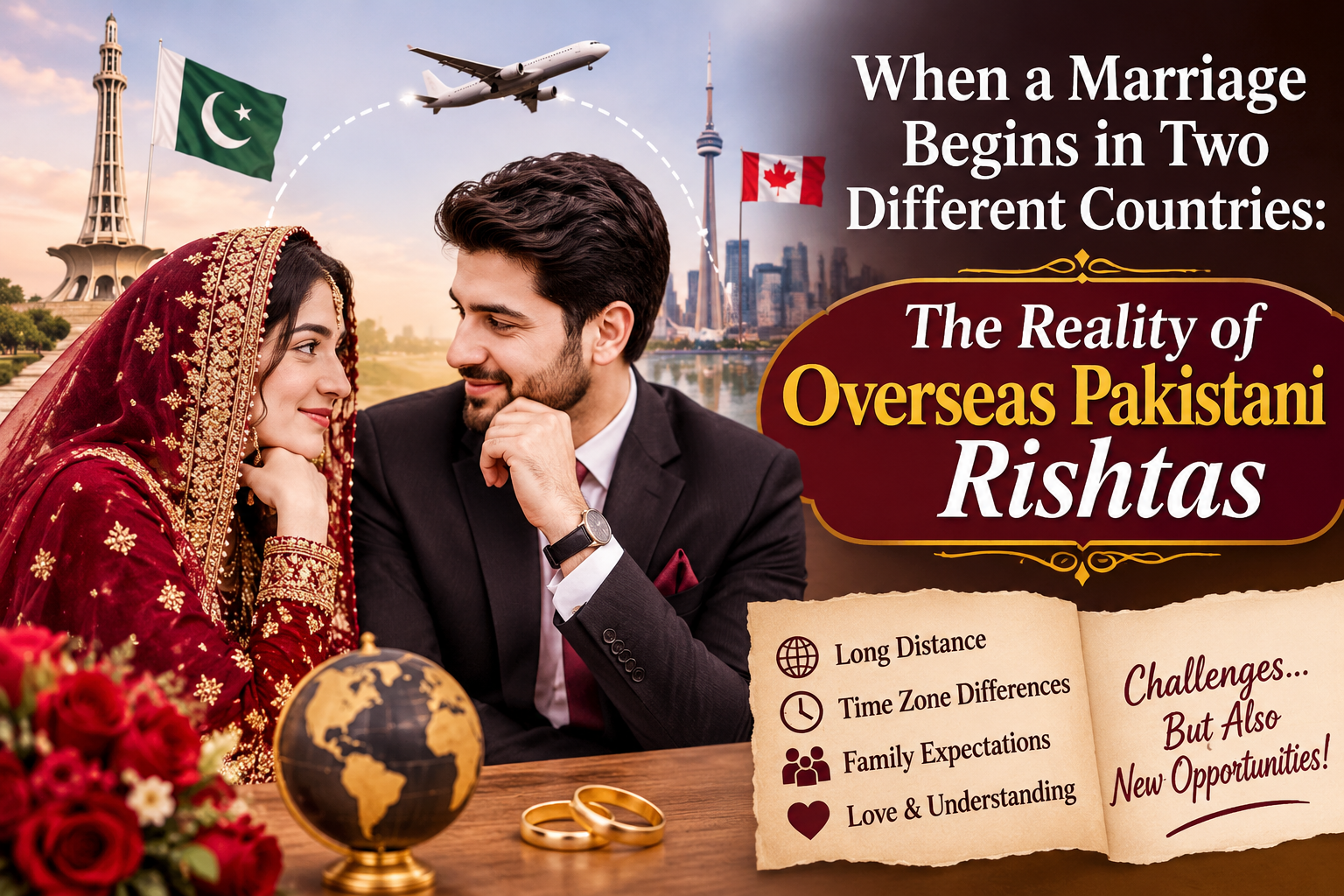
An overseas Pakistani marriage proposal can appear promising from the beginning. One individual may live in the United Kingdom, another in Pakistan. A family may have relatives settled in Canada, while another may be considering a future in Australia or the United States. The geographical distance between these families can make a matrimonial proposal seem like an opportunity for a completely different future.
However, a marriage that connects two countries also connects two daily realities. The individuals may have grown up with different social experiences, developed different routines and learned to understand family responsibilities through different circumstances. Even when they share the same language, heritage and religious values, their expectations about married life may not automatically be identical.
This is an important distinction that families sometimes overlook while evaluating an overseas rishta. Living abroad is a geographical circumstance, not a complete description of someone's character, lifestyle, financial stability or suitability as a marriage partner.
The central question is not simply where a potential partner lives. It is whether both individuals understand the practical, emotional and cultural adjustments involved in building a shared life across different backgrounds and countries.
For overseas Pakistani families and individuals searching for marriage, the most valuable decisions are often made before an engagement is announced or travel arrangements begin. This guide explores the subjects that deserve careful attention before accepting an overseas matrimonial proposal.
In This Article
- Looking Beyond the Attraction of Living Abroad
- The Reality Gap Between Two Countries
- Relocation and the Life Left Behind
- Immigration Expectations and Honest Discussions
- Family Responsibilities Across Borders
- Financial Compatibility and Lifestyle Differences
- Communication Across Time Zones
- Preserving Cultural Identity After Marriage
- Questions to Discuss Before Accepting a Proposal
- Mistakes and Warning Signs to Recognize
- Building a Marriage That Can Cross Borders
1. Looking Beyond the Attraction of Living Abroad
One of the first challenges in overseas matrimonial searches is separating the attraction of a foreign country from the qualities of the individual who lives there.
A person residing in London, Toronto, Melbourne or New York may have professional opportunities and access to a different lifestyle. These circumstances can be attractive to someone considering marriage and relocation. Nevertheless, geographical location does not automatically indicate emotional maturity, financial security, personal integrity or compatibility.
A person living abroad may have significant financial responsibilities, demanding working hours, family obligations or immigration restrictions. Someone living in Pakistan may possess strong professional ambitions, independence and a clear understanding of their future.
Neither individual should be evaluated through assumptions about their country of residence.
A more meaningful approach is to understand the person behind the location. What kind of life have they built? What responsibilities do they carry? How do they manage difficult situations? What are their expectations from marriage?
Families exploring different matrimonial opportunities can begin by understanding the specific requirements of their preferred destinations through MatchFusion's USA matrimonial section, UK matrimonial section and Canada matrimonial section.
The objective should be to identify a compatible person rather than treating an overseas address as proof of a successful future.
2. The Reality Gap Between Two Countries
Two people can share a cultural identity while experiencing very different everyday environments. This difference becomes particularly important when one individual has spent most of their adult life abroad and the other has lived primarily in Pakistan.
Consider the ordinary structure of a working day. Someone living overseas may leave home early, travel a considerable distance to work, return late and have limited time for social gatherings. Their routine may be shaped by independent living, workplace commitments and household responsibilities.
The other individual may be accustomed to a household in which relatives regularly visit, family members share responsibilities and social interaction is part of everyday life.
Neither lifestyle is inherently better. The challenge appears when both individuals assume that their own routine will automatically become the shared routine after marriage.
This reality gap can affect several areas:
- Social interaction: How frequently do they expect to visit relatives and attend family gatherings?
- Daily routines: What do their working hours, household duties and personal commitments look like?
- Independence: How much individual decision-making are they accustomed to?
- Privacy: What does personal space mean to each person?
- Community: How important are friendships, cultural events and connections with other Pakistani families?
A successful transition requires curiosity rather than judgment. Each individual should be willing to understand the circumstances that shaped the other's expectations.
3. Relocation and the Life Left Behind
Relocation is frequently discussed as an exciting possibility during overseas marriage conversations. Moving to another country may offer new educational opportunities, professional development and the experience of building an independent household.
Yet relocation also involves leaving behind familiar surroundings, relationships and routines. For someone moving from Pakistan to another country, even simple activities can initially feel unfamiliar.
The nearest grocery store may be difficult to reach without a vehicle. Weather conditions may change everyday habits. Public transport, workplace expectations and healthcare arrangements may operate differently. A person who previously lived close to parents and siblings may suddenly need to manage daily responsibilities without their immediate support.
These adjustments deserve recognition before marriage, not after the individual arrives in their new country.
The importance of discussing the first year
Couples should discuss what their first year together might realistically involve. Will the relocating partner be able to work immediately, or might immigration conditions affect employment? Will further education be considered? How will household responsibilities be divided? What support will be available during the adjustment period?
It is equally important to discuss the emotional side of relocation. Missing parents, familiar food, childhood friends and cultural celebrations is not necessarily a sign of dissatisfaction with married life.
A supportive spouse recognizes that adapting to a new environment takes time. Rather than dismissing these feelings, both partners can work together to develop a comfortable routine and maintain meaningful family connections.
A new country can provide a different beginning, but a sense of belonging is something two people must build through patience, understanding and everyday companionship.
4. Immigration Expectations and Honest Discussions
One of the most important practical subjects in an overseas rishta is immigration. Families should understand that marriage and immigration are related in some circumstances, but they are not the same legal process.
Marriage does not automatically provide permission to enter, reside or work in another country. Eligibility depends on the destination country's laws, the sponsor's circumstances, the applicant's situation and the relevant immigration requirements.
For example, the United Kingdom has a family visa route for eligible partners and spouses. The requirements include relationship evidence and other conditions that applicants must satisfy. Families can consult the official UK Government family visa guidance before making assumptions.
In Canada, eligible citizens and permanent residents may be able to sponsor qualifying spouses or partners through the family sponsorship system. The official Canada spouse and partner sponsorship guidance explains the relevant process and responsibilities.
For the United States, the US Department of State's spouse immigrant visa information describes the family immigration route for eligible applicants.
Australia also has different partner visa pathways depending on the circumstances of the applicant and sponsor. The Australian Department of Home Affairs partner visa information explains the available categories.
These examples demonstrate why families should never assume that a particular immigration route will be available simply because a potential partner lives overseas.
What should be clarified before marriage?
- The potential partner's current immigration and residency status.
- Whether the individual is legally eligible to sponsor a spouse under the relevant rules.
- Whether the intended marriage and supporting documents will satisfy applicable legal requirements.
- Who will be responsible for gathering and submitting documents.
- Whether any previous immigration applications or refusals need to be disclosed.
- How the couple will manage their lives if processing takes longer than expected.
It is particularly important to avoid promises such as guaranteed permanent residency, immediate employment or a fixed visa approval date. No matrimonial platform, family member or private individual can guarantee a decision made by an immigration authority.
For country-specific decisions, always consult the relevant government immigration website or a properly authorized immigration professional. This article provides general matrimonial information, not legal or immigration advice.
5. Family Responsibilities Across Borders
Marriage does not remove existing family responsibilities. In many Pakistani households, individuals maintain close relationships with their parents, siblings and extended relatives even after settling abroad.
These connections can remain important emotionally and financially. Someone living in another country may regularly support parents, contribute to household expenses in Pakistan or arrange visits when family circumstances require attention.
A future spouse should understand these commitments before marriage. Similarly, the individual living abroad should understand that relocation may create new responsibilities towards their partner.
A common source of misunderstanding occurs when one person expects financial independence after marriage while the other considers supporting parents a permanent responsibility. Neither expectation should be hidden during matrimonial discussions.
Finding a reasonable balance
A healthy arrangement begins with transparency. Couples should discuss how frequently they hope to visit Pakistan, whether parents may eventually visit them overseas and how important family occasions will be managed.
They should also discuss financial support for parents without creating unrealistic promises. The goal is to understand what each person can reasonably contribute while protecting the financial stability of the new household.
Respecting a spouse's family should not require neglecting one's own parents. Equally, family obligations should not become a reason to disregard the emotional and practical needs of the marriage.
For couples with roots in Pakistan, exploring Pakistani matrimonial connections can also help maintain an understanding of family traditions and cultural expectations.
6. Financial Compatibility and Lifestyle Differences
Financial compatibility becomes especially important when two people have different economic experiences. A person living abroad may earn in a foreign currency, while the other may have a career or financial commitments in Pakistan.
However, comparing salaries without understanding living expenses can create a misleading picture.
Housing, transportation, insurance, taxation, utilities, childcare and other daily expenses can significantly influence disposable income. Someone with a seemingly attractive salary may also have substantial financial obligations.
A potential partner should not be evaluated solely through income figures. Financial maturity is reflected in how a person manages resources, communicates responsibilities and plans for future needs.
Financial subjects worth discussing
- Current employment and realistic career expectations.
- Monthly household expenses and savings priorities.
- Existing debts, loans or significant financial commitments.
- Financial support provided to parents or relatives.
- Expectations about whether both partners will work.
- Plans for housing, transportation and future investments.
- Arrangements for managing money as a married couple.
There is also an important emotional dimension to financial compatibility. One person may consider purchasing a home an immediate priority, while the other may prefer saving for education or establishing a secure emergency fund.
These differences are not necessarily reasons to reject a proposal. They become manageable when both individuals communicate honestly and develop realistic shared priorities.
7. Communication Across Different Time Zones
Before an overseas marriage, communication may depend heavily on phone calls, messaging applications and scheduled video conversations. These interactions can help individuals become familiar with each other's personalities, but they do not always represent the complete experience of living together.
Time differences can make communication difficult. One person may be preparing for work while the other is finishing the day. Weekends may not align, and professional commitments may interrupt conversations.
The quality of communication is therefore more important than the number of messages exchanged.
A couple should understand whether they can discuss uncomfortable subjects without becoming defensive. They should also recognize that delayed replies do not automatically indicate a lack of interest.
Developing realistic communication habits
Rather than expecting constant availability, couples can establish reasonable communication routines. They may agree on suitable times for longer conversations, keep each other informed about significant changes and discuss expectations around privacy and digital boundaries.
More importantly, important subjects should not be avoided simply because conversations happen remotely.
Questions about children, household responsibilities, family involvement, career decisions and relocation should receive the same attention as they would in an in-person matrimonial meeting.
Before a commitment is made, both individuals should have adequate opportunities to communicate freely, ask questions and express concerns. Families can support this process by creating an environment in which honest discussion is respected.
8. Preserving Cultural Identity After Marriage
An overseas Pakistani may have spent many years adapting to another country's education system, workplace culture and social environment. Their connection with Pakistani traditions may remain strong, but the way they practice those traditions can differ from someone who has lived in Pakistan throughout their life.
For example, someone raised abroad may be comfortable preparing their own meals, sharing household responsibilities equally or making independent decisions about social activities. Another individual may have grown up in a more traditional family structure.
These differences should be explored with respect rather than treated as evidence that one person is more traditional or more modern than the other.
Cultural identity is not limited to clothing, language or celebrations. It also includes values, family relationships, personal beliefs and the ways individuals understand responsibility.
Couples can create their own household traditions while maintaining meaningful connections with their heritage. They might celebrate Pakistani festivals, prepare familiar dishes, speak their preferred languages at home and introduce future children to cultural traditions.
The purpose is not to reproduce exactly the environment in which either person grew up. It is to build a shared identity that respects both backgrounds.
9. Questions to Discuss Before Accepting an Overseas Marriage Proposal
Some matrimonial conversations remain focused on education, profession and family background because these details are easy to exchange. However, an overseas marriage involves additional decisions that can shape everyday life for years.
A thoughtful conversation should cover practical matters as well as personal expectations.
Questions about the individual
- What does your ordinary working day look like?
- What responsibilities currently occupy most of your time?
- What do you appreciate most about your present lifestyle?
- How do you normally manage disagreements or stressful situations?
- What kind of relationship do you hope to build after marriage?
Questions about relocation
- Where would the couple expect to live after marriage?
- What immigration pathway, if any, may be relevant?
- What could the initial adjustment period look like?
- Will the relocating spouse be able to pursue employment or further education?
- What arrangements would be made if relocation takes longer than expected?
Questions about family and responsibilities
- How frequently do you expect to visit your parents in Pakistan?
- What financial responsibilities do you currently have towards family members?
- How much involvement should both families have in personal decisions?
- What are your expectations regarding future children and parenting?
- How will household responsibilities be divided?
These questions should be discussed mutually. They are not intended to turn a matrimonial meeting into an examination. Rather, they provide a framework for understanding whether two individuals can make important decisions together.
10. Mistakes and Warning Signs to Recognize
The attraction of an overseas proposal can sometimes cause families to overlook questions they would normally consider important. This is why careful verification and patience are essential.
A few situations deserve particular attention.
Accepting claims without verification
Important information about employment, residence, marital history and immigration status should be discussed and appropriately verified. Families should not rely entirely on photographs, verbal promises or assumptions about someone's overseas lifestyle.
Making immigration promises part of emotional pressure
Statements promising guaranteed visas, permanent residency or immediate relocation should be treated cautiously. Immigration outcomes depend on applicable laws and individual circumstances, not matrimonial assurances.
Ignoring existing marital or financial responsibilities
Previous marriages, children, financial commitments and other significant responsibilities should be disclosed honestly. Hiding such information can undermine trust before married life even begins.
Rushing the decision
An individual should not be pressured into accepting a proposal simply because the potential partner lives overseas or because a family believes the opportunity may not come again.
Disregarding personal boundaries
Controlling communication, demanding private documents unnecessarily, using financial promises to create dependence or refusing reasonable questions can indicate unhealthy behaviour.
A responsible matrimonial decision allows both individuals sufficient time to understand the proposal. If important information remains unclear, postponing a commitment is often wiser than relying on assumptions.
11. Building a Marriage That Can Cross Borders
An overseas marriage should not be measured by the distance one partner travels or the country in which the couple eventually settles. Its deeper foundation lies in how two individuals respond to the responsibilities they share.
There will be practical decisions involving accommodation, careers, family visits and finances. There may also be periods when one individual misses familiar surroundings or feels uncertain about their place in a new environment.
These experiences do not automatically indicate an unsuccessful marriage. They are circumstances that require communication, patience and mutual support.
Both partners should have the freedom to express their concerns without feeling that their feelings are being compared or dismissed. The person who relocates should receive reasonable support in developing independence, while the partner already established abroad should not be expected to abandon every existing responsibility.
A strong marriage is built when neither individual treats adjustment as the responsibility of only one person.
Couples can create stability by making decisions together, dividing responsibilities fairly, maintaining healthy family relationships and recognizing each other's efforts.
Most importantly, they should understand that moving to a new country does not automatically solve personal or relationship difficulties. A change of location can create opportunities, but the quality of married life depends on the way both individuals treat one another.
How MatchFusion Matrimony Fits Into the Overseas Rishta Journey
Finding a compatible marriage partner can become more complicated when families are searching across several countries. Differences in location, family circumstances, professional backgrounds and future expectations make clear communication particularly important.
A matrimonial platform can provide an organized starting point for individuals and families who are looking for marriage with serious intentions.
At MatchFusion Matrimony, the purpose of connecting matrimonial proposals is not simply to introduce people based on their location. A meaningful introduction should help families understand the individuals behind the profiles and encourage conversations about values, expectations and future plans.
Whether someone is exploring matrimonial opportunities in the United States, the United Kingdom, Canada or Australia, the decision should ultimately be based on mutual understanding and accurate information.
You can explore the available USA matrimonial opportunities, UK rishta connections, Canadian matrimonial section and Australian matrimonial opportunities to learn more about the platform.
For information about the platform and its approach to matrimonial connections, visit the About MatchFusion Matrimony page. Families who need further information can also use the Contact Us page.
Frequently Asked Questions About Overseas Pakistani Marriage
1. What should families consider before accepting an overseas Pakistani rishta?
Families should understand the potential partner's identity, employment, immigration status, family responsibilities, lifestyle, financial circumstances and expectations about married life. A proposal should be evaluated through verified information and mutual compatibility rather than country of residence alone.
2. Is an overseas Pakistani marriage more difficult than a marriage within Pakistan?
Not necessarily. However, overseas marriages may involve additional considerations, including relocation, time differences, immigration procedures, cultural adjustment and distance from family. Honest discussions before marriage can help couples prepare for these responsibilities.
3. Should visa arrangements be discussed before marriage?
Yes. Both individuals should discuss the possible immigration route, eligibility, documentation, sponsorship responsibilities and realistic timelines. Visa approval is determined by the relevant government authority and cannot be guaranteed by a potential spouse or matrimonial service.
4. How can someone adjust to life abroad after marriage?
Adjustment can become easier through practical preparation, emotional support, learning about local services, developing social connections and maintaining communication with family. Both partners should recognize that adapting to a different environment takes time.
5. What if one partner wants to return to Pakistan in the future?
Long-term location preferences should be discussed before marriage. Couples should consider career opportunities, family responsibilities, financial circumstances and personal priorities before deciding where they wish to establish their future home.
6. How can families verify an overseas matrimonial proposal?
Families can have direct conversations, check relevant identity and employment information with appropriate consent, understand the person's actual residency circumstances and verify significant claims through reliable sources. They should also be careful with financial requests and unsupported promises.
7. Can an overseas Pakistani couple maintain their cultural identity?
Yes. Couples can maintain their language, family relationships, traditions, cultural celebrations and values while also adapting to their new surroundings. The approach depends on their shared priorities and willingness to respect each other's backgrounds.
8. What is the most important quality in an overseas marriage?
There is no single quality that guarantees a successful marriage. Honesty, mutual respect, emotional maturity, realistic expectations, communication and shared responsibility are all important foundations for building a stable relationship.
Final Thoughts: A Marriage Is More Than a Journey Between Countries
An overseas Pakistani rishta can bring together two people whose lives have been shaped by different environments, experiences and responsibilities. That difference can offer opportunities for growth, but it also requires a willingness to understand what each person brings into the relationship.
A passport cannot reveal someone's patience. A foreign address cannot establish someone's character. A professional achievement cannot explain how a person handles family responsibilities. These qualities become clear through honest conversations, responsible decisions and consistent behaviour.
Before accepting a proposal, take the time to understand not only where the other person lives, but also how they think, what they value and what kind of future they genuinely wish to build.
Because the real success of an overseas marriage is not measured by how far someone travels to begin a new life. It is measured by whether two individuals can make that life meaningful for both of them.
Official Resources and Further Reading
The following government resources provide information about family immigration and identity-related services. Requirements can change, so readers should consult the latest official guidance for their individual circumstances.