When Marriage Means Moving Countries: The Relocation Plan Every Couple Should Discuss
A marriage that connects two people from different countries can also connect two different lifestyles, legal systems, financial realities and family environments. Before packing suitcases and booking flights, couples need a plan that goes beyond the wedding itself.

For some couples, marriage begins in one city and continues in another country. One partner may already have an established career in London, Toronto or Sydney, while the other has spent their entire life in Pakistan or another home country. Their decision to build a life together may involve much more than choosing where to celebrate their wedding.
International relocation can introduce unfamiliar responsibilities. A spouse may need to understand a new immigration process, find suitable accommodation, rebuild professional connections and learn how everyday services work. Even couples who have known each other for years can discover that they have never discussed these practical details in enough depth.
The important question is not simply which country offers a better opportunity. It is whether both people understand what moving there will actually mean for their shared life.
A thoughtful relocation plan allows couples to make decisions with realistic expectations instead of relying on assumptions. It also helps both partners participate in building their future rather than treating the move as one person's responsibility.
Inside This Guide
- Choosing a country as a shared decision
- Understanding immigration requirements
- Preparing important documents
- Planning the first home
- Understanding the financial transition
- Protecting both partners' careers
- Healthcare and everyday essentials
- Managing distance from family
- Building a routine in a new country
- A practical relocation timeline
- Mistakes couples should avoid
- Frequently asked questions
1. Choosing a Country Should Be a Shared Decision
When an international marriage is being planned, the destination country is sometimes treated as an already settled matter. One partner lives abroad, so the assumption becomes that the other person will simply join them after marriage.
However, the country where a couple lives will influence both partners' daily experiences. A destination that offers professional opportunities to one spouse may create career difficulties for the other. A familiar language for one person may be completely unfamiliar to their partner.
Before making a final commitment, discuss the practical advantages and disadvantages of the proposed destination.
Questions worth discussing together
- Will both partners be comfortable with the local language?
- Is the destination suitable for the careers and qualifications of both individuals?
- Will the couple live independently or with relatives?
- How accessible will public transport, healthcare and essential services be?
- Are there communities or social networks that can help the new spouse settle?
- Would another city offer better opportunities or a more manageable cost of living?
- What happens if the first relocation plan does not work?
These questions are not reasons to delay marriage unnecessarily. They are ways to understand the environment in which the marriage will develop.
2. Understand Immigration Requirements Before Making Promises
One of the biggest planning mistakes in international marriages is assuming that a marriage certificate automatically provides permission to live or work in another country.
Immigration systems have their own eligibility requirements. The process may involve sponsorship, relationship evidence, financial documentation, medical checks, language requirements or other conditions depending on the destination and the applicant's circumstances.
For example, the UK has a specific family visa route for eligible partners who want to live with a family member for more than six months. The United States has immigrant visa procedures for certain foreign spouses of US citizens. Canada's family sponsorship system also has its own eligibility requirements.
These systems are not interchangeable. Approval under one country's rules does not mean that another country will follow the same process.
What couples should verify
- Which visa category applies to the relationship?
- Who is eligible to sponsor the applicant?
- What financial requirements apply?
- Which relationship documents are accepted?
- Are language tests or medical examinations required?
- Can the arriving spouse work or study?
- What are the expected application stages and possible delays?
Read the UK Family Visa Guide →
Read the US Spouse Immigrant Visa Guide →
Read Canada's Spousal Sponsorship Requirements →
Couples should always check the latest official rules for their particular situation. If a case is complicated, a qualified immigration lawyer or authorised professional in the relevant jurisdiction may be appropriate.
3. Create a Document Plan Instead of Collecting Papers at the Last Minute
International relocation often requires documents from more than one country. Some records may need official certification, translation or verification before they can be used in an application.
A marriage certificate, for example, may be essential in one application, while another process may request additional evidence about the relationship or the sponsor's financial position.
Rather than preparing everything based on online discussions or another person's experience, make a document checklist using the official instructions for the specific visa category.
Documents to investigate in advance
- Valid passports and previous travel records
- Official marriage registration or marriage certificate
- Birth certificates and identity documents where required
- Financial statements or income evidence
- Evidence of the relationship, if requested
- Police certificates, where applicable
- Medical examination records, if required
- Certified translations of documents in other languages
- Education and professional qualification records
- Copies of relevant immigration correspondence
It is useful to maintain a secure digital folder and a separate physical folder. Give files clear names and keep copies of submitted applications, receipts and official communication.
Do not send original identity documents to unofficial agents or unknown individuals. Use the submission method specified by the relevant government authority.
Review Family Visa Information and Evidence →
4. Plan the First Home Before the Arrival
The first accommodation after relocation can have a significant influence on how comfortable the transition feels.
A partner arriving in an unfamiliar country may not immediately understand rental agreements, neighbourhood differences, public transport routes or local housing costs. If these details have not been discussed, the first few weeks can become unnecessarily stressful.
The couple should agree on a realistic initial housing arrangement. It might be a rented apartment, an existing family home or temporary accommodation while they explore longer-term options.
Housing decisions to settle
- Location: How close is the home to work, public transport and essential services?
- Privacy: Will both partners have the level of independence they expect?
- Costs: What are the rent, security deposit, utility bills and other charges?
- Transport: Can both partners travel conveniently?
- Safety: Have they researched the area and its local facilities?
- Future needs: Will the accommodation remain suitable if circumstances change?
Couples should also discuss their expectations around living with parents or extended family. A housing arrangement that seems temporary to one person may be understood as permanent by the other.
Clarity before relocation can prevent misunderstandings after arrival.
5. Understand the Financial Transition as a Couple
Moving to another country can change the way a household earns, spends and saves money. Even if one spouse already has a stable income, the arrival of another person may introduce new expenses and responsibilities.
The couple should estimate their monthly household costs before deciding how much money they need for the move.
Build a realistic relocation budget
- Visa and application-related expenses
- Travel tickets and baggage charges
- Initial accommodation and housing deposits
- Food and everyday household purchases
- Transport and communication expenses
- Healthcare or insurance costs
- Clothing and essential items for the new climate
- Professional registration or qualification assessment fees, if applicable
- Emergency savings for unexpected expenses
It is equally important to discuss how financial decisions will be made after the move. Some couples prefer joint accounts, others maintain separate accounts, while many use a combination of both.
There is no single arrangement that works for every household. What matters is that both people understand their responsibilities and have reasonable access to information about shared expenses.
Read the Couples and Financial Commitment Research →
For a deeper look at how financial expectations influence marriage, readers can also explore our article on building a decent and balanced marriage.
6. Protect Both Partners' Career Opportunities
A common challenge in international marriages is that one person may have an established professional life while the other is starting from the beginning.
A degree or professional qualification earned in one country does not necessarily provide automatic access to the same profession elsewhere. Licensing rules, language requirements, local experience and employer expectations can differ significantly.
This is especially important for teachers, healthcare professionals, engineers, accountants and people working in regulated occupations.
Prepare a career transition plan
Before relocating, each partner should research whether their qualifications are recognised in the destination country. They can also identify professional registration requirements, suitable job markets and any additional training that may be necessary.
If immediate employment is not possible, discuss alternative plans such as further education, language development, certification or a temporary period of financial support.
The goal should not be to make one person's professional ambitions more important than the other's. Both partners should have an opportunity to rebuild or continue their working lives.
Explore Australia's Settlement Topics →
7. Healthcare and Everyday Essentials Need Their Own Plan
People sometimes focus so heavily on immigration approval and travel arrangements that they forget about everyday necessities.
Healthcare access is one of the most important examples. A new resident's entitlement to public healthcare may depend on their immigration status, country of residence and local regulations.
Couples should find out whether private insurance is needed, how to register with a local healthcare provider and what to do in an emergency.
Other essentials to investigate
- How to obtain a local mobile number
- How to open a bank account, if eligible
- Public transport cards and travel options
- Local emergency services and important telephone numbers
- Prescription rules and access to necessary medicines
- Driving licence recognition and local driving regulations
- Nearby grocery stores, pharmacies and medical facilities
If a partner takes regular medication, they should check the destination country's rules before travelling. Medicines that are commonly available in one country may be regulated differently elsewhere.
The couple should also keep emergency contacts and important medical information accessible.
Read the Moving Abroad Guidance →
8. Discuss Family Responsibilities Before the Move
In international marriages, relocation does not always involve only two people. Parents, siblings and other relatives may be an important part of each partner's life.
One spouse may expect frequent visits to their home country, while the other may have financial or caregiving responsibilities toward family members. These expectations can become difficult when the couple lives thousands of kilometres away.
It helps to discuss family responsibilities before relocating instead of waiting until a disagreement arises.
Important family arrangements
- How often does the couple expect to visit their families?
- Who will manage travel expenses for family visits?
- Will either partner need to provide regular financial assistance?
- How will important family events be managed across different countries?
- Will relatives be expected to visit the couple regularly?
- How will the couple handle emergencies involving family members abroad?
There is no universal answer to these questions. Different families have different needs and traditions. The important thing is to make expectations clear and create arrangements that both spouses understand.
A practical approach to family responsibilities can also help couples maintain their connections with loved ones without neglecting their own household.
9. Give the New Spouse Time to Build an Independent Life
Relocating after marriage can create an unusual situation. One partner may already know the city, understand its systems and have a network of friends and colleagues. The other may be entering an environment where almost everything is unfamiliar.
Even simple activities, such as visiting a supermarket, arranging transport or making a medical appointment, may require additional effort.
The arriving spouse should have time to become familiar with the area and develop confidence in handling everyday responsibilities.
Small steps that make settling easier
- Explore the local neighbourhood together.
- Identify nearby shops, healthcare facilities and transport links.
- Learn useful local expressions and everyday communication.
- Explore educational and professional opportunities.
- Maintain healthy connections with friends and family back home.
- Develop hobbies and activities outside the household.
- Agree on regular time to discuss what is working and what needs attention.
It is also helpful for the partner who already lives in the destination country to understand that familiarity cannot be transferred instantly. Patience and practical support are more useful than expecting the newcomer to adjust immediately.
At the same time, the arriving spouse should be encouraged to develop independence and personal interests. Building a new social and professional network can make the destination feel more like home.
10. A Practical Relocation Timeline for Couples
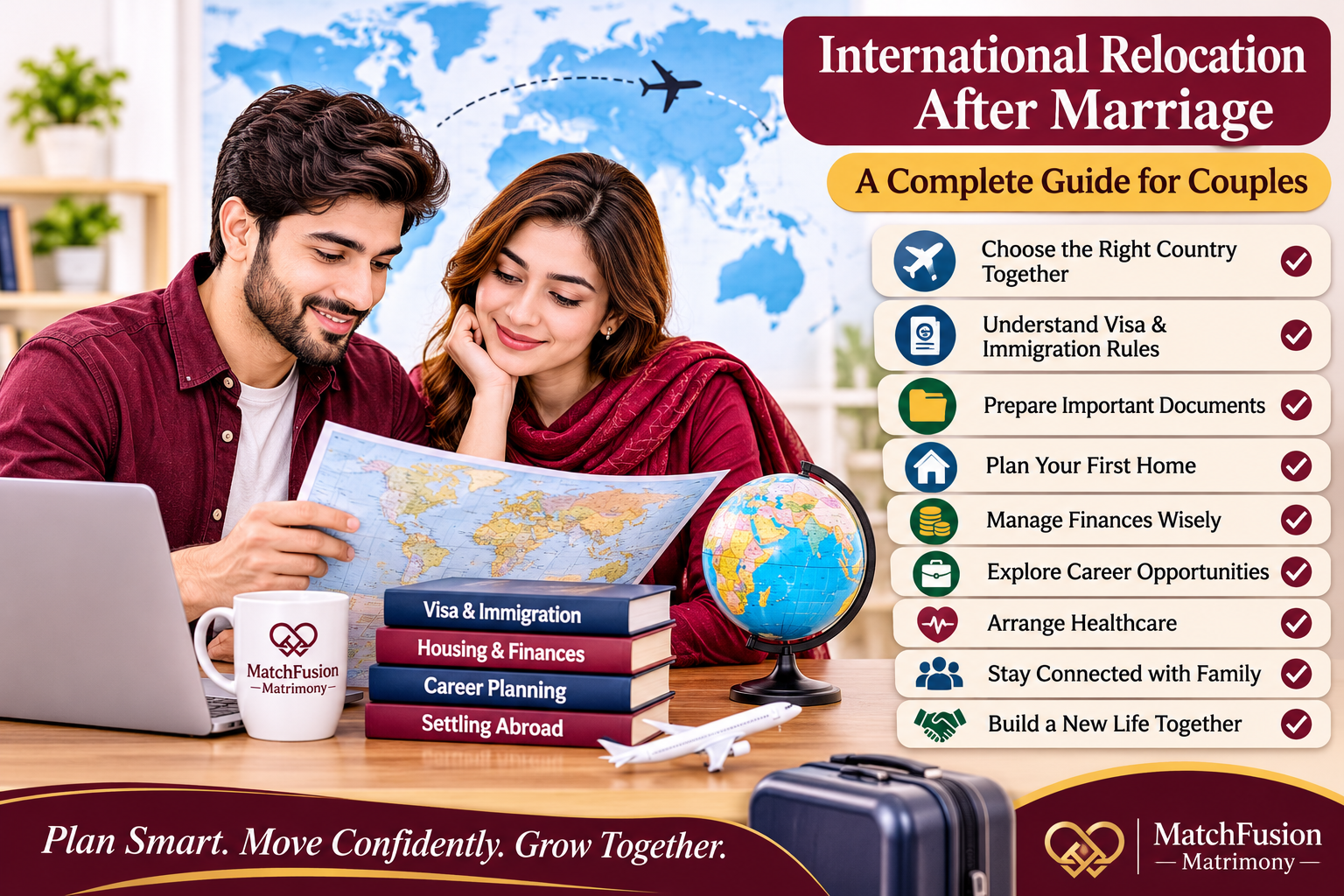
A relocation plan becomes easier to manage when major responsibilities are divided into stages. The exact timeline will vary depending on the destination, visa category and personal circumstances, but the following framework can help couples organise their preparations.
Stage One: Before the marriage or relocation decision
- Discuss the preferred country and city.
- Review the available immigration routes.
- Discuss housing, employment and family expectations.
- Estimate the financial resources required.
- Identify any major obstacles that need professional advice.
Stage Two: During immigration preparation
- Follow the official document checklist.
- Arrange certified translations where necessary.
- Collect financial and relationship evidence if requested.
- Complete relevant medical or language requirements.
- Keep copies of applications and official communication.
Stage Three: Before travelling
- Confirm that the required travel permission has been granted.
- Arrange initial accommodation.
- Review baggage and airline requirements.
- Plan the arrival journey and airport collection.
- Prepare emergency contacts and essential documents.
Stage Four: After arrival
- Complete any required residence or registration procedures.
- Understand healthcare and banking arrangements.
- Explore employment and education opportunities.
- Establish a household budget.
- Create a realistic routine and settling-in plan.
11. Relocation Mistakes Couples Should Avoid
Many difficulties associated with international relocation do not arise because couples lack commitment. They arise because important decisions were never discussed in practical terms.
Assuming marriage guarantees immigration approval
A legally recognised marriage does not automatically satisfy every country's immigration requirements. Eligibility, evidence and application procedures must be checked separately.
Planning only for the travelling spouse
The partner already living abroad may have an established routine, but the arriving spouse needs their own plan for work, social connections, independence and everyday activities.
Ignoring the cost of settling in
Travel expenses are only one part of the financial commitment. Housing deposits, insurance, transportation, household essentials and periods without employment should also be considered.
Making assumptions about living arrangements
Couples should discuss whether they will live alone or with relatives, how household responsibilities will be shared and what level of privacy each person expects.
Relying on outdated online information
Visa rules and application procedures can change. A process that worked for a friend several years ago may no longer apply. Official government resources should remain the primary reference.
Expecting immediate adjustment
Building a new life takes time. Professional, social and cultural adjustment may happen at different speeds for each partner. A realistic approach is better than placing pressure on one another to settle immediately.
12. The Best Relocation Plan Is One Both Partners Understand
Moving abroad after marriage can open opportunities for education, professional development, travel and a different way of life. It can also introduce responsibilities that couples may not have encountered before.
The most useful preparation is not simply a folder of documents or a confirmed flight reservation. It is a shared understanding of what each person expects from the move and how they will manage the responsibilities that follow.
A couple may not be able to predict every challenge, but they can make informed decisions about immigration, accommodation, finances, employment and family commitments.
For people considering an international marriage, these conversations are worth having before making major commitments. A future built in another country should be planned with the participation of both people who will live it.
At MatchFusion Matrimony, we believe that understanding compatibility also means looking beyond initial introductions and considering the practical circumstances that shape a shared future.
You can explore our international matchmaking sections: USA Matrimony, UK Matrimony, Canada Matrimony and Europe Matrimony.
Frequently Asked Questions
1. What should couples discuss before moving abroad after marriage?
They should discuss immigration eligibility, housing, finances, employment, healthcare, family responsibilities and their expectations about everyday life in the destination country.
2. Does getting married automatically allow a spouse to move abroad?
No. Each country has its own immigration rules. A marriage certificate may be part of an application, but additional eligibility conditions and supporting evidence may be required.
3. Can a spouse work immediately after moving to another country?
Not necessarily. Employment rights depend on the particular visa or residence status. Couples should confirm work permission with the destination country's official immigration authority.
4. What documents may be required for international marriage relocation?
Depending on the destination, documents may include passports, marriage certificates, identity records, financial evidence, relationship evidence, police certificates, medical records and certified translations.
5. Should couples prepare accommodation before travelling?
It is generally helpful to arrange safe initial accommodation or have a clear housing plan before arrival. Both partners should understand the expected costs, location and living arrangements.
6. How should couples manage financial responsibilities after relocation?
They should agree on a household budget, shared expenses, personal spending, savings and emergency funds. The arrangement should be transparent and practical for both people.
7. How can someone adjust to a new country after marriage?
Learning local systems, exploring the neighbourhood, developing professional and social connections and maintaining communication with family can make the adjustment process more manageable.