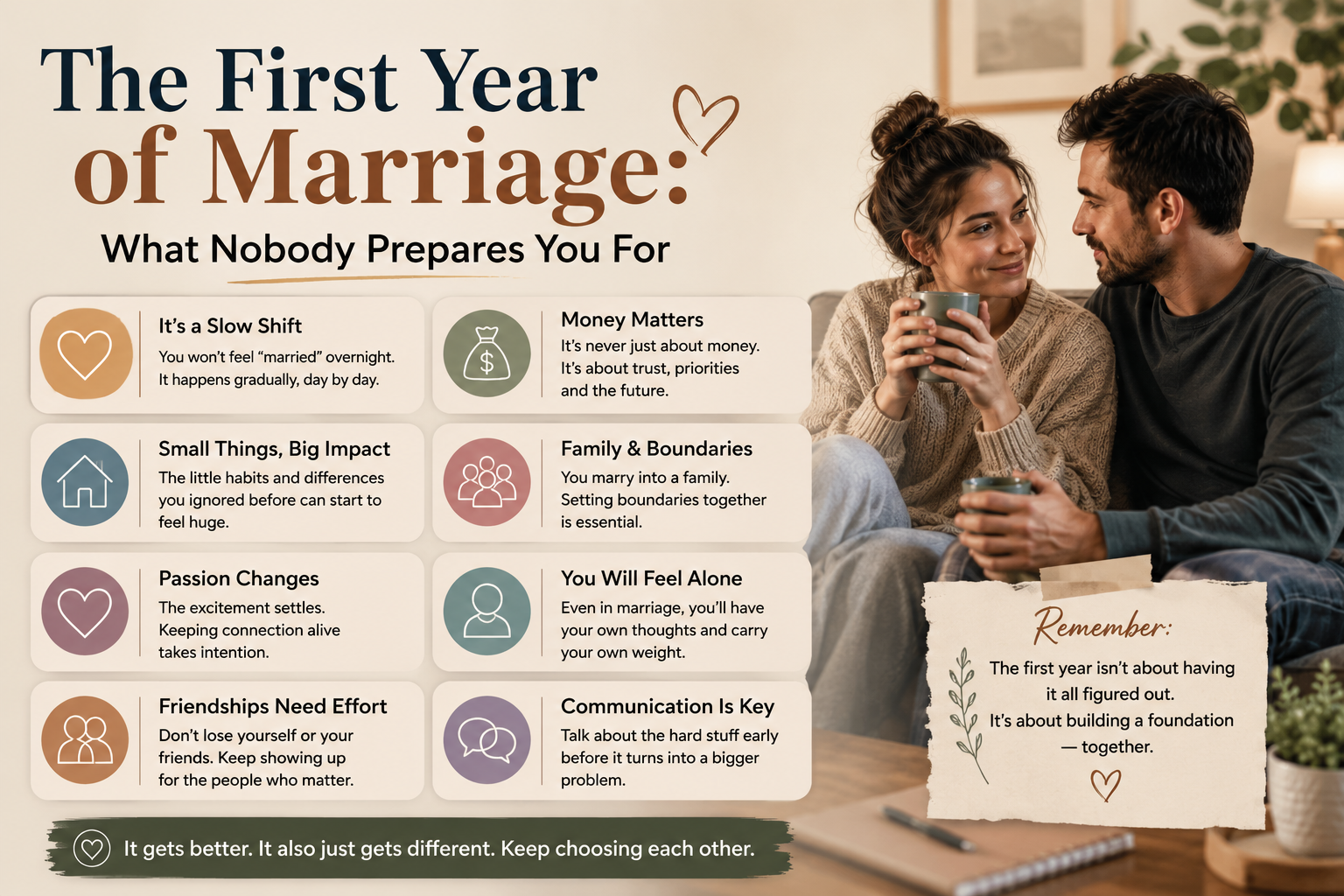
You plan the wedding for months. You say the vows, cut the cake, do the dances, smile through what feels like a thousand photos. Then comes the part almost nobody actually talks about — the part that starts the next morning, once the guests have flown home and the leftover cake is going stale on the counter and it's just the two of you again, except now with all these expectations riding on top.
People call the first year the hardest one, and I used to think that was dramatic until I lived it. It's not that marriage is bad. It's that it's genuinely different from dating, different from just living together, different from anything you've done before, even if you'd already been sharing an apartment for two years like Ravi and I had.
The morning after our wedding I woke up and felt... exactly the same. Same thoughts, same annoying habit of checking my phone before I'm even fully awake, same everything. Meanwhile there was apparently a piece of paper somewhere saying I was a different person now. Somebody's wife. That gap between what you expect to feel and what you actually feel can throw you off more than you'd think. You wait to feel married and it just doesn't arrive on schedule.
💭 The first truth: You won't feel married overnight. The shift happens slowly, over months — you start saying "we" without noticing, you start weighing someone else's feelings. Give it time.
It turns out the shift happens slowly, over months, not overnight. You start saying "we" without noticing you've switched from "I." You start weighing someone else's feelings before you make a decision that used to be purely yours. There's no need to rush it — the marriage is already there whether you feel different or not, and the feeling eventually catches up on its own time.
Living Together Is Different When There's No Exit
Living together before the wedding, we thought we'd already done the hard part. We hadn't, not really. Married and living together is different because there's no exit anymore — no going back to "my place" for a few days to cool off, because this is the only place now, for both of you. Suddenly the smallest things start to matter way more than they should. How he squeezes the toothpaste from the middle. Whether dishes go straight in the dishwasher or sit in the sink overnight (they sat, always, for weeks it felt like). Whether you're someone who needs quiet in the morning or someone who wants to talk through the whole day's plan over coffee. None of it's really that important on its own — it just adds up because there's nowhere to escape it anymore. We fought about the thermostat more times that year than I'd like to admit, and it was never actually about the thermostat.

Money, Family, and the Hard Conversations
Then there's money, which nobody wants to discuss before the wedding because it feels unromantic, so most couples just say "we'll figure it out" and leave it there. Then the actual bills show up and you're staring at a joint account wondering why nobody warned you it would feel this complicated. Money talk is really relationship talk in disguise — trust, security, what you each think the future should look like — it just gets dressed up as a spreadsheet. You'll probably have at least one real fight about it that first year. We had two, one over a car repair and one, embarrassingly, over how much I'd spent on a coat. It's not really about being identical in how you handle money. It's about finding some shared system, whatever that looks like for you two, and actually talking about it before it turns into a crisis.
Family gets complicated fast, too. You didn't just marry a person — you married their whole extended family, with opinions about everything from where you should live to when you're having kids to whether you're seeing them often enough. That first year tends to be when boundaries actually get drawn for the first time, out loud, which can be awkward and occasionally painful, especially if you were raised with very different rules around family. The couples who get through it tend to be the ones who decide things together first and present a united front after, instead of letting either set of parents wedge in between them.
The Passion Fades — And That's Normal
The passion fades some, and this one nobody wants to say out loud either. That early stretch where you couldn't keep your hands off each other doesn't last — not because the attraction disappears, but because ordinary life crowds it out. Work, being tired, early mornings, the general grind. You'll probably have less sex than you did while dating, and that's not automatically a red flag, it's just what happens when two exhausted people share one bed and one alarm clock. The risk is letting "less" quietly become "almost none," which is how couples start to feel like roommates instead of partners. The ones who keep the connection alive usually just decide to — scheduling it sounds unromantic but it works, and honestly a lot of intimacy isn't even about sex at all. It's a hand on your shoulder while you're doing dishes. A kiss before either of you has brushed your teeth. Ten minutes of actual conversation before you fall asleep instead of scrolling your phones side by side.
❤️ Truth about passion: Less sex in year one doesn't mean something's broken. It's normal. What matters is staying connected — small gestures, real conversation, choosing each other even when you're tired.
Sometimes You're Just Not That Happy
Here's the part that's hardest to admit: sometimes, in that first year, you're just not that happy. Not constantly, anyway. You spend your whole life hearing marriage described as the best thing that'll ever happen to you, and then you're standing in your kitchen at 9pm irritated about something small, wondering what's wrong with you that this doesn't feel the way the movies promised. Nothing's wrong with you. Marriage is wonderful and also, a lot of the time, just normal — and normal isn't thrilling by definition. You can love someone completely and still feel a little disappointed on a random Tuesday. Both things can be true at once. The point of the first year, as far as I can tell, isn't chasing constant happiness — it's building the kind of commitment that happiness eventually grows out of, on its own schedule.
Friends slip away quietly if you're not paying attention. You cancel plans because you'd rather be home with your spouse. You stop calling as often because "married life" keeps you busy. And then one day you notice you haven't actually talked to your closest friend in three months, and your entire social world has narrowed down to one other person. That's not healthy, no matter how good the marriage is — nobody should have to be everything for you. The people who avoid this problem just keep showing up for their friendships on purpose, even when it would be easier not to.

The Stupid Fights and What They Really Mean
You'll fight about genuinely stupid things that year. Which way the toilet paper hangs. Who forgot to buy milk again. How the dishwasher gets loaded, apparently there's a right way and a wrong way and we still disagree. None of these fights are really about the object in question — they're about feeling unheard, or wanting some sense of control over a life that suddenly has another whole person's preferences tangled up in it. Once you realize that, you can actually address what's underneath instead of refighting the dishwasher argument for the fortieth time. And sometimes the only real fix is laughing at yourselves, because it is genuinely funny how angry two grown adults can get over a sponge.
You think you know someone after years of dating and living together. Then you marry them and discover you didn't know them quite as well as you assumed — not because they were hiding anything, but because certain things about a person only show up once the exit door is gone. A temper you'd never seen. An anxiety that only surfaces under permanent commitment. A level of stubbornness that dating somehow never revealed. These surprises can rattle you at first, but they're also just the invitation to actually know the whole person instead of the highlight reel you dated.
The Moments You End Up Keeping
For everything hard about it, that first year also hands you moments you end up keeping for good. Quiet mornings in pajamas, coffee going cold, nobody saying much because nothing needs saying. Bad movies and worse takeout on a Sunday. The specific way he still looks up and smiles when I walk into a room, three years later. Nobody warns you how much the ordinary stuff ends up mattering more than any big gesture ever did.
If I could go back and say one thing to myself that first September, married three weeks and slightly panicking, it'd be this: struggling doesn't mean you picked wrong. You're not supposed to have it figured out yet. Marriage isn't a test with a pass or fail attached to it — it's a foundation, and foundations take longer to set than anyone tells you going in. Be patient with yourself. Be patient with him. Give both of you more grace than feels natural.
🌟 The real secret: Struggling in year one doesn't mean you picked wrong. Marriage isn't a test — it's a foundation, and foundations take time to set. Be patient with each other.
The first year ends faster than you expect it to. One day you just notice you've made it a full year, and you can see how much you've both changed already, and also how much further there is to go. That's the actual shape of marriage — not a finish line, a long thing you build together one unglamorous day at a time. The hard parts count as much as the good ones. It gets better. It also just gets different, over and over, for as long as you keep choosing each other — which, it turns out, is the whole job description.
💍 Final thought: The first year isn't about getting it right — it's about building a foundation. Keep choosing each other, one ordinary day at a time. That's what actually lasts.