Divorce Procedure in Pakistan: Talaq Notice, Arbitration Council and Iddat
Divorce is one of the most difficult decisions a married couple may face. In Pakistan, ending a marriage involves more than a private conversation or a verbal announcement. The legal process may require written notice, communication with the Union Council, reconciliation proceedings through an Arbitration Council and completion of a statutory waiting period. For many families, questions about Iddat, pregnancy, Khula, children's rights and official divorce documents can make the situation even more confusing.
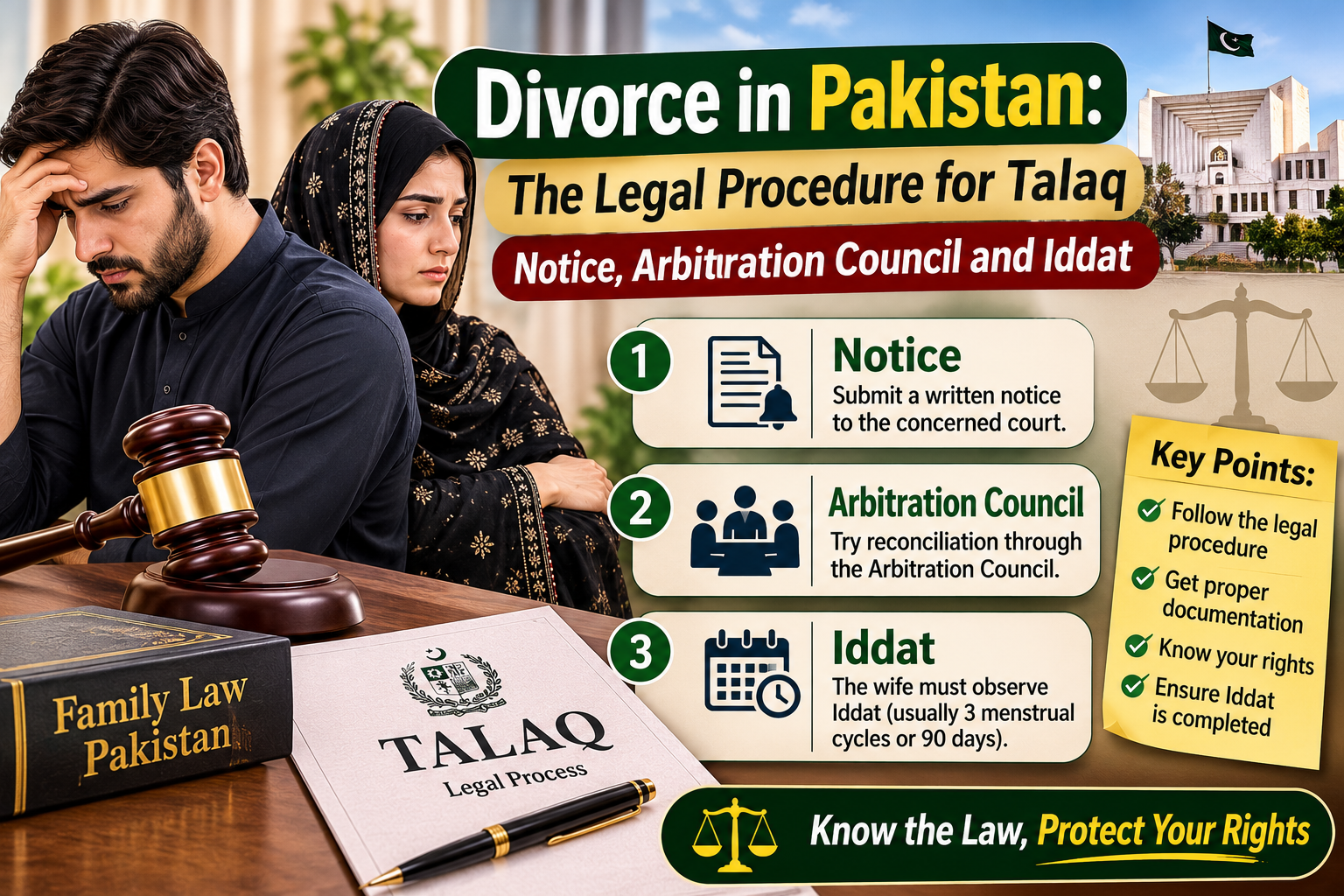
This guide explains the general legal procedure for Muslim marriages under Pakistan's family-law framework. It focuses particularly on Section 7 of the Muslim Family Laws Ordinance, 1961. It also discusses how a husband's talaq notice differs from a wife's application for Khula or judicial dissolution.
1. Which Law Governs Divorce in Pakistan?
The Muslim Family Laws Ordinance, 1961 is an important part of Pakistan's family-law framework. Section 7 deals with talaq and establishes a procedure involving written notice, the Chairman of the relevant Union Council, reconciliation efforts and a statutory waiting period.
The Ordinance applies to Muslim citizens of Pakistan wherever they may be. This is particularly relevant to overseas Pakistanis who may be living in the United Kingdom, United States, Canada, the Gulf countries or elsewhere. However, the correct authority, service of documents and recognition of a Pakistani divorce abroad can involve additional legal questions.
Section 7(1) requires a husband who has pronounced talaq to give written notice to the Chairman and supply a copy to his wife. The law then provides for an Arbitration Council and a period before the talaq becomes effective, unless it is revoked earlier.
The exact application of family law can also depend on personal-law considerations. For example, Section 7 contains specific provisions relating to Fiqah-e-Jafria. Therefore, people should not assume that every individual case can be handled using one generic online explanation.
You can read the relevant provisions in the text of Section 7 of the Muslim Family Laws Ordinance.
2. Step One: Giving Written Talaq Notice
After pronouncing talaq, the husband is required under Section 7(1) to give written notice to the Chairman of the relevant Union Council. He must also supply a copy of that notice to his wife.
This requirement is important because the legal procedure is not based solely on what the spouses tell their relatives or what is announced verbally. The written notice creates an official record and allows the statutory process to begin.
What information should the notice contain?
The notice should clearly identify the parties and communicate that talaq has been pronounced. The relevant office may ask for supporting documents or particular information according to its current administrative requirements.
Commonly requested records may include:
- Names and identification details of both spouses.
- Copy of the registered Nikahnama.
- CNIC or other accepted identity documents.
- Date and relevant details of the pronouncement.
- Written notice submitted to the Chairman.
- Copy of the notice supplied to the wife.
Why proof of delivery is important
One detail deserves special attention: Section 7(3) calculates the 90-day period from the day the notice is delivered to the Chairman. It does not simply begin from the date a document was drafted or the day the couple discussed separation.
For this reason, the person submitting the notice should keep a receiving stamp, acknowledgement, registered-post record or other reliable proof showing when the relevant office received it.
Section 7(2) also provides a penalty for contravening the written-notice requirement. The stated penalty is simple imprisonment for up to one year, a fine up to five thousand rupees, or both. The consequences of a particular failure to comply should be assessed by a qualified lawyer.
3. Which Union Council Should Receive the Notice?
Selecting the correct Union Council is another important part of the process. Under Rule 3(b) of the West Pakistan Rules under the Muslim Family Laws Ordinance, the Union Council with jurisdiction for a talaq notice is generally the Union Council of the area where the wife was residing at the time talaq was pronounced.
The Rules also provide for certain situations in which the wife was not residing in the relevant territory at that time. For example, where she was previously residing with the husband in Pakistan, the applicable rule may refer to the Union Council of the area where she last resided with him. Other circumstances may require a different approach.
The official text is available in the West Pakistan Rules under the Muslim Family Laws Ordinance.
What if the wife lives abroad?
Overseas residence can make the process more complicated. The applicable rules contain provisions for situations where the wife is not residing in the relevant territory. They also address certain circumstances where her whereabouts are unknown and notice cannot be served despite due diligence.
A husband should not choose a Union Council simply because it is close to his current home. The residence facts at the relevant time and the applicable jurisdiction rules should be checked before filing.
4. Step Two: The Arbitration Council and Reconciliation Process
Once the Chairman receives the written notice, Section 7(4) requires the formation of an Arbitration Council within 30 days. Its purpose is to make efforts toward reconciliation between the spouses.
The Arbitration Council generally consists of the Chairman and representatives nominated by each party, subject to the applicable law and rules. The process provides an opportunity for the spouses to consider whether the marriage can be restored.
What happens during reconciliation?
The Council may contact the parties, issue notices and arrange proceedings. Both spouses may be asked to nominate representatives and participate in the process. The relevant rules also provide procedures for nominations and the conduct of proceedings.
The purpose is not simply to complete paperwork. Reconciliation is intended to give both parties an opportunity to consider their situation before the statutory process reaches its conclusion.
What should spouses keep in mind?
- Read official notices carefully and respond within the required time.
- Keep telephone numbers and addresses accurate.
- Attend proceedings when required by the relevant authority.
- Communicate honestly if reconciliation is genuinely desired.
- Do not sign an agreement without understanding its consequences.
- Keep copies of important correspondence and decisions.
The Arbitration Council's role should not be confused with the role of a Family Court. Disputes about maintenance, child custody, dower, dowry articles or other claims may require separate legal proceedings.
5. Step Three: Understanding the 90-Day Legal Period
The 90-day period is one of the most misunderstood parts of the divorce process in Pakistan.
Section 7(3) states that, unless talaq is revoked earlier, it does not become effective until 90 days have expired from the day the written notice is delivered to the Chairman.
This means that the date of pronouncement and the statutory date of effectiveness are not necessarily identical. The law provides a period during which reconciliation can be attempted and talaq may be revoked.
How the process generally moves forward
Talaq is pronounced
The husband pronounces talaq. The written-notice requirement under Section 7(1) should then be followed.
Written notice is delivered
The notice reaches the Chairman of the relevant Union Council. This delivery date is the statutory starting point for calculating the 90 days under Section 7(3).
Arbitration Council is constituted
The Chairman is required to constitute the Council within 30 days of receiving the notice to attempt reconciliation.
The statutory period continues
The 90-day period runs, subject to any revocation and the special rule concerning pregnancy.
Legal effectiveness and official record
If the legal conditions are met and talaq has not been revoked, it becomes effective under Section 7. The parties should obtain the relevant official record and confirm any remaining registration requirements.
A person should not calculate the final date only by counting from a verbal announcement. The actual date of delivery to the Chairman matters. Delayed service, missing documents, disputed facts or pregnancy can affect the legal position.
The Supreme Court has also considered the statutory effect of talaq and the importance of Section 7's notice and waiting-period framework. Readers can review the relevant discussion through the legal text and judicial interpretations of Section 7.
6. What If the Wife Is Pregnant?
Pregnancy is specifically addressed in Section 7(5) of the Muslim Family Laws Ordinance.
If the wife is pregnant at the time talaq is pronounced, the law provides that talaq does not become effective until the end of the 90-day period mentioned in Section 7(3) or the end of the pregnancy, whichever occurs later.
For example, if the pregnancy continues beyond the 90-day period, the statutory date of effectiveness is postponed until the pregnancy ends. If the pregnancy ends before the 90 days expire, the statutory period still has to run.
This provision is one reason why every case should be assessed according to its actual facts. Pregnancy-related dates and relevant records should be communicated accurately to the authority handling the matter.
If there is a pregnancy loss, uncertainty about dates or a disagreement about the relevant circumstances, the parties should obtain professional legal advice rather than trying to calculate the result from a general online article.
7. Iddat After Divorce: Understanding the Religious Waiting Period
Iddat is a religious waiting period observed by a Muslim woman after certain forms of marital dissolution or the death of her husband. Its duration and calculation depend on the circumstances and the applicable interpretation of Islamic personal law.
It is important not to describe Iddat as simply another name for the Union Council's 90-day legal period. The two concepts relate to different questions.
General principles concerning Iddat
- Menstruating divorcee: The Qur'an refers to a waiting period of three quru'. Islamic legal schools interpret this term differently.
- Pregnant woman: The Qur'an states that the waiting period of pregnant women continues until they deliver.
- Women who do not menstruate: Qur'an 65:4 addresses the waiting period for women who have ceased menstruating and those who do not menstruate.
- Divorce before consummation: Qur'an 33:49 addresses the situation in which divorce occurs before the marriage has been consummated.
Readers can consult the relevant religious texts at Qur'an 2:228, Qur'an 65:4 and Qur'an 33:49.
Is Iddat always exactly 90 days?
No. It is not accurate to claim that every woman's Iddat is automatically 90 days. The religious calculation may depend on menstrual cycles, pregnancy, whether the marriage was consummated and the applicable school of thought.
The statutory 90-day period under Section 7 is calculated from delivery of the notice to the Chairman. Iddat is a separate religious question. In some circumstances the periods may overlap, but they should not automatically be treated as identical.
Does the Union Council decide the religious calculation of Iddat?
The Union Council administers the statutory notice and reconciliation process and maintains the relevant civil record. Questions about the religious calculation of Iddat should be discussed with a qualified religious scholar familiar with the circumstances. Questions about the legal date of effectiveness should be confirmed with a family-law lawyer or the relevant authority.
8. Khula Is Different From a Husband's Talaq
Not every divorce begins with a husband issuing a talaq notice. A wife who wants to end her marriage may seek Khula or pursue judicial dissolution through the Family Court on an applicable legal ground.
These routes should not be confused with one another. The correct legal approach depends on the claim, the evidence, the Nikahnama and the circumstances of the marriage.
What is Khula?
Khula is a form of dissolution sought by a wife through the court. Financial consequences, including questions concerning dower or Haq Mehr, should be considered according to the facts, applicable law and the court's decision.
A person should not assume that every Khula case automatically produces the same financial outcome. The Nikahnama, payment records, pleadings and court decree can all matter.
Judicial dissolution on legal grounds
A wife may also seek dissolution under the Dissolution of Muslim Marriages Act, 1939, where a recognised legal ground is available. This is not necessarily the same as choosing Khula.
A significant Supreme Court decision announced in October 2026 discussed the importance of distinguishing a wife's statutory claim for dissolution from Khula. The Court explained that a Family Court should not convert a statutory dissolution claim into Khula without the wife's clear and voluntary choice. Read the summary of the Supreme Court decision concerning Zainab Bibi and Iram Naz Begum.
What happens after a Family Court decree?
Section 21-B of the Family Courts Act, 1964 provides that when a Family Court decrees dissolution of a Muslim marriage, it must send a certified copy of the decree to the concerned Chairman of the Arbitration Council immediately and no later than three days from the decree.
The Chairman then proceeds as if the relevant intimation of talaq under the Muslim Family Laws Ordinance has been received. The provision can be read in the Family Courts Act published by the Ministry of Law and Justice.
9. Documents to Keep During the Divorce Process
The documents required can vary according to the local authority and the type of dissolution. Before submitting original papers, ask the relevant office for its current requirements.
- Copy of the registered Nikahnama or marriage registration record.
- CNIC copies or other accepted identity documents.
- Written talaq notice or relevant Family Court decree.
- Proof of delivery to the Chairman or Union Council.
- Evidence that a copy was supplied to the wife, where applicable.
- Union Council notices and correspondence.
- Relevant pregnancy documentation, where Section 7(5) applies.
- Certified copies of the final order or official certificate.
Obtaining a divorce registration certificate
After the relevant legal process has reached the required stage, the parties should ask the concerned Union Council or local registration authority about the official divorce or dissolution record.
A computerised Divorce Registration Certificate may be requested for future administrative purposes. However, the exact name of the document, issuing authority, fees and supporting papers should be confirmed locally.
Keep the official record and any court decree safely. These documents may be required for future marriage registration, immigration matters, changes to official records or other administrative procedures.
10. Children's Rights, Maintenance and Haq Mehr After Divorce
Divorce does not automatically settle every issue between former spouses. Child maintenance, custody, visitation, dower, dowry articles, personal belongings and other financial claims may need separate discussion, settlement or court proceedings.
Child maintenance and custody
Children should not be treated as part of a dispute between adults. Their welfare, education, healthcare, daily routine and emotional stability deserve careful consideration.
A divorce notice alone should not be assumed to settle custody or remove a parent's financial responsibilities. If the parents cannot agree, they should obtain advice about the appropriate Family Court proceedings.
Haq Mehr and financial claims
The Nikahnama should be reviewed carefully before making decisions about dower or other financial matters. Khula and judicial dissolution can have different legal consequences. A spouse should not sign a waiver, settlement or receipt without understanding which rights it may affect.
For further reading about marriage responsibilities, readers can explore our guide on Nikah Nama and marriage documents in Pakistan.
11. Common Mistakes That Can Create Legal Problems
Many difficulties arise not because the law is impossible to understand, but because people rely on assumptions or incomplete information. The following mistakes should be avoided:
- Assuming verbal pronouncement completes every legal step: Section 7 requires written notice to the Chairman and a copy to the wife.
- Sending notice to the wrong Union Council: The applicable jurisdiction rules and residence circumstances matter.
- Counting 90 days from the wrong date: Section 7(3) refers to the date the notice is delivered to the Chairman.
- Ignoring Arbitration Council communication: Official notices and proceedings should be taken seriously.
- Confusing Iddat with the statutory waiting period: They are not automatically identical.
- Overlooking pregnancy: Section 7(5) may affect the statutory date of effectiveness.
- Assuming Khula and talaq are the same: They involve different legal routes.
- Failing to obtain official records: Keep certified documents for future administrative requirements.
- Signing settlements without advice: Financial and personal rights may be affected.
12. Handling Divorce With Dignity and Accurate Information
Legal procedure is only one part of a difficult family situation. Divorce can affect the emotional and practical lives of spouses, children and extended families. Where it is safe and freely chosen by both parties, respectful communication or professional counselling may help clarify whether reconciliation is possible.
However, reconciliation should never be used to pressure someone into remaining in an unsafe relationship or surrendering a legal right. If there is intimidation, violence, coercion or a threat to personal safety, prioritise safety and seek appropriate local support.
Both spouses deserve accurate information, respectful treatment and access to independent advice. Important decisions about divorce should not be based only on rumours, social media posts or informal opinions from people who are unfamiliar with the law.
At MatchFusion Matrimony, our aim is to help readers understand important family and relationship matters with greater awareness. You can also explore our articles about the first year of marriage, forgiveness and rebuilding trust and marriage considerations for overseas Pakistanis.
Frequently Asked Questions
1. Is written notice necessary after pronouncing talaq in Pakistan?
Yes. Section 7(1) requires the husband to give written notice to the Chairman and supply a copy to the wife. The handling of a disputed or unusual case should be checked with a lawyer.
2. Does talaq become legally effective immediately?
Under Section 7(3), talaq generally does not become effective until 90 days have expired from the day the notice is delivered to the Chairman, unless it is revoked earlier. The pregnancy rule in Section 7(5) may extend the period.
3. When is the Arbitration Council formed?
Section 7(4) requires the Chairman to constitute an Arbitration Council within 30 days of receiving the notice. Its purpose is to make efforts toward reconciliation.
4. Which Union Council is responsible for a talaq notice?
Under Rule 3(b), it is generally the Union Council for the area where the wife was residing when talaq was pronounced. Special rules may apply in overseas-residence or other exceptional situations.
5. What happens if the wife is pregnant?
Section 7(5) provides that talaq does not become effective until the 90-day period or the pregnancy ends, whichever is later.
6. Is Iddat the same as the 90-day legal period?
No. The 90-day period is a statutory rule calculated from delivery of notice to the Chairman. Iddat is a religious waiting period whose calculation depends on the circumstances and applicable Islamic interpretation.
7. Can a wife seek divorce without her husband's agreement?
A wife may approach the Family Court for Khula or seek judicial dissolution on an applicable legal ground. The correct route and its consequences depend on the claim, evidence, Nikahnama and current law.
8. Does a Khula case also involve the Union Council?
When a Family Court decrees dissolution, Section 21-B requires the court to send a certified copy of the decree to the concerned Chairman, who then proceeds under the relevant family-law procedure.
9. What document should be kept after divorce?
Keep the certified court decree, where applicable, the Union Council's final record or divorce registration certificate, and proof of important notices and submissions. Confirm the precise document required for your future purpose.
10. Can overseas Pakistanis use the Pakistani divorce process?
The Muslim Family Laws Ordinance states that it applies to Muslim citizens of Pakistan wherever they may be. However, jurisdiction, service of notice and recognition in another country can be complex, so obtain advice in the relevant jurisdictions.
Legal Sources and Further Reading
This article is an educational overview. Readers who want to understand the legislation and religious references in more detail can consult the following sources:
- Muslim Family Laws Ordinance, 1961 — published by the Sindh Judicial Academy.
- West Pakistan Rules under the Muslim Family Laws Ordinance, 1961 — Pakistan Code.
- Section 7: Talaq — text of the statutory notice and waiting-period provisions.
- Family Courts Act, 1964 — Ministry of Law and Justice.
- Supreme Court decision concerning statutory dissolution and Khula — case summary of the October 2026 decision.
- Qur'an 2:228, Qur'an 65:4 and Qur'an 33:49 — religious references relevant to waiting periods.
Explore More Marriage Guidance
Discover more practical articles about marriage, compatibility, family responsibilities and important decisions on MatchFusion Matrimony.
Explore Marriage AdviceDisclaimer: This article is for general educational information only and is not legal, religious or medical advice. Laws, rules, administrative practices and judicial interpretations may change. The correct procedure can depend on the province or territory, personal-law interpretation, residence, pregnancy, the wording and date of pronouncement, service of notice and court orders. Consult a qualified Pakistani family-law lawyer and the relevant Union Council before taking action. For religious questions about Iddat, consult a qualified scholar familiar with your circumstances.