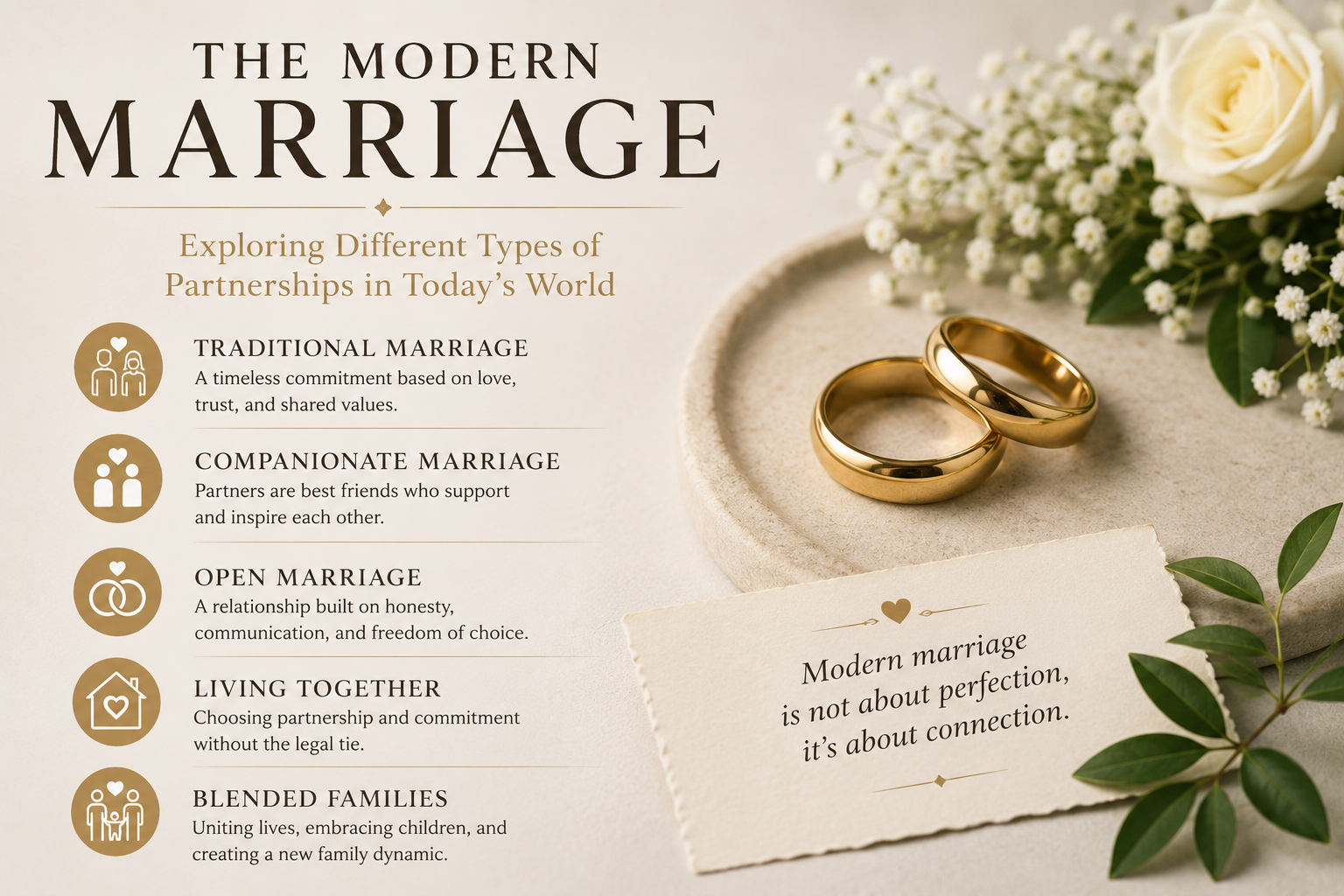
Say "marriage" and most people picture the same thing — a man, a woman, a white dress, a ceremony, a lifetime of monogamy. Still the default in most people's heads. But marriage today looks a lot messier than that picture once you actually start paying attention to how people are building their lives.
Knowing the different shapes marriage can take isn't just trivia for a slow afternoon. It can genuinely help you figure out what you actually want, instead of just defaulting to whatever version you grew up watching at home.
Beyond the Traditional: Understanding Marriage in All Its Forms
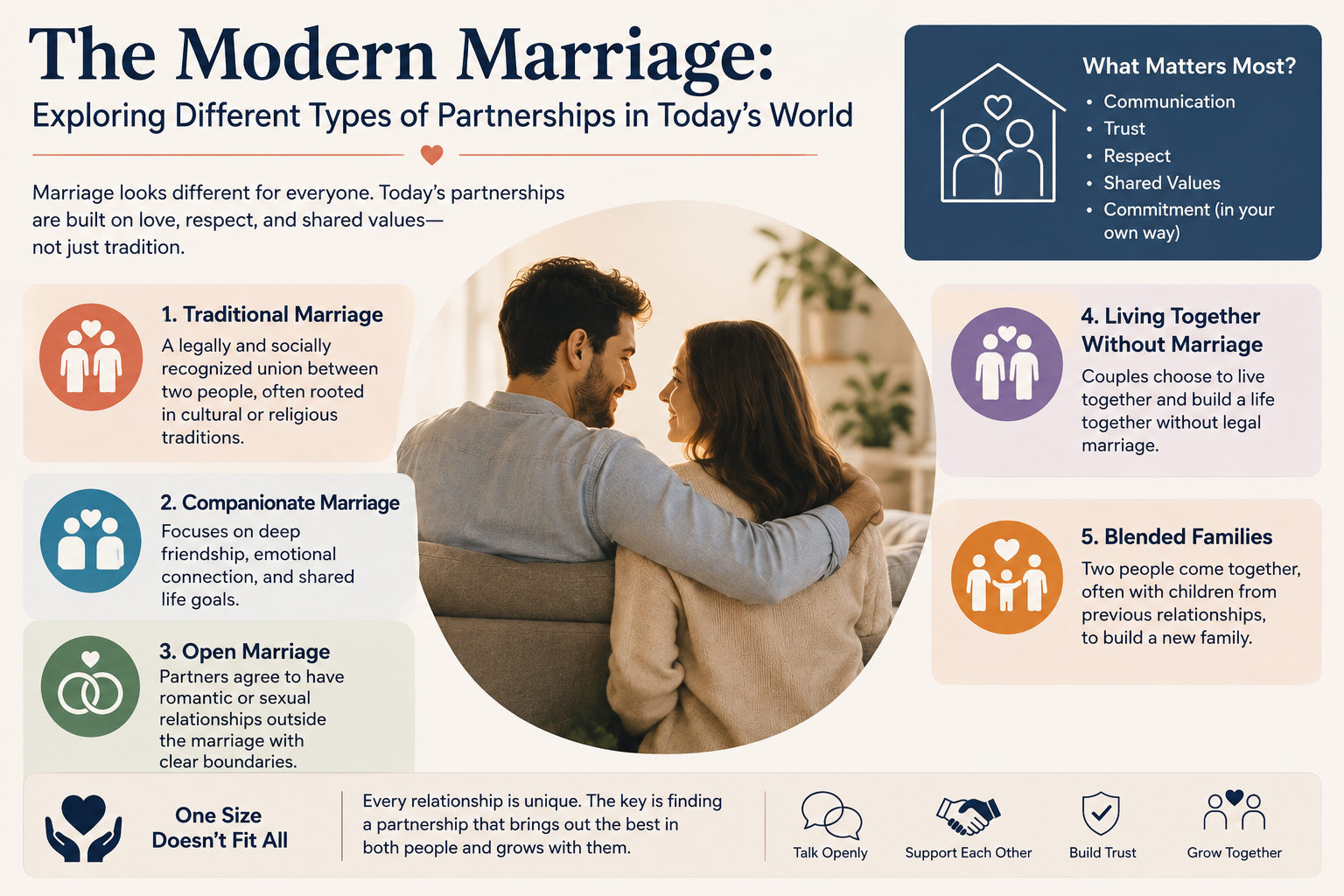
Traditional Marriage
The classic version everyone pictures first — heterosexual couple, religious or civil ceremony, an expectation that it lasts forever, husband earning and wife running the house (though that split's loosened up a lot by now), kids, monogamy assumed by default.
Worth saying though — "traditional" has never really meant one fixed thing. Victorian England and ancient Rome had wildly different ideas of what counted as a proper marriage, and what's traditional in India today looks nothing like what's traditional in Japan. For plenty of couples this model just works — clear expectations, built-in support, something that's been tested across generations. It's just not right for everyone, and it never was.
Arranged Marriages
Still common across South Asia, the Middle East, parts of Africa. And despite what a lot of Westerners assume, it's not the same as forced marriage — in a real arranged match, both people can actually say no. Families usually weigh reputation, money, education, religion, sometimes astrology too.
Here's the genuinely interesting part — research keeps finding arranged marriages can be just as stable as love marriages long-term, sometimes more so. Probably because expectations tend to be more realistic going in, and there's a whole extended family invested in the thing working, not just two people figuring it out alone at 2am. A lot of these have quietly turned into "semi-arranged" setups anyway — families introduce, couples actually decide.
Love Marriages
The opposite approach — people choosing each other purely because they want to, romantic attraction doing the heavy lifting. Once seen as unconventional in a lot of places, now the dominant model across the West and spreading fast.
The upside's obvious — personal choice, actual romance. What doesn't get talked about as much is the cost. Without much family involvement, couples can end up with nobody outside the relationship to lean on during hard stretches. And because the emotional stakes feel so personal, conflicts hit harder. There's also this pattern where couples go in with a somewhat idealized picture, the early passion cools eventually the way it always does, and it catches them off guard — nobody warned them love actually needs upkeep to survive.
Open Marriages
Probably the most argued-about type here. Couples agree outside sexual or emotional relationships are fine, within limits they've actually talked through — swinging, polyamory, "monogamish," relationship anarchy, all different flavors of the same basic idea.
People who choose this say it takes pressure off one person having to be everything, gives more personal freedom, and honestly can deepen trust since total honesty becomes non-negotiable. But it asks for a level of communication most people never had to develop before. Jealousy and plain logistics trip up even couples who are genuinely committed to it, and the data does suggest these marriages fail more often than monogamous ones when people jump in without doing the groundwork first.
💡 Key Insight: Open marriages require radical honesty and exceptional communication skills — they're not a shortcut, but a different path that works for some.
Companionate Marriages
Here the foundation isn't passion — it's friendship, shared interests, being genuinely easy to be around. Usually less emphasis on sex than other models. Shows up a lot with couples marrying later in life, or people who already had one intense romance blow up on them and aren't in a rush for round two of that particular ride.
The strength is realism. Without the constant pressure to keep things romantically intense, there's usually less conflict, steadier satisfaction. The tradeoff — some people here quietly miss the passion they know they're not getting.
Mixed-Faith & Intercultural Marriages
World keeps getting smaller, so marriages across religions, cultures, nationalities keep getting more common — bringing genuine richness along with real friction. On the good side: real cultural exposure, a wider worldview, communication that has to be stronger just out of necessity, since you can't coast on shared assumptions. On the harder side: mismatched family expectations, real questions about how to raise kids, and sometimes actual logistical headaches like immigration or language.
The couples who pull it off tend to share a few things — genuine curiosity about the partner's culture instead of polite tolerance, willingness to build new traditions instead of one culture quietly winning, and shared values underneath even when daily life looks totally different on the surface.
Same-Sex Marriages
Legal recognition's expanded a lot in recent decades, though still restricted in plenty of places. These marriages often come with more freedom from traditional gender-role baggage, sometimes a shared experience of discrimination that ends up bonding the couple tighter, different routes to parenthood — adoption, surrogacy, donor insemination — and often a stronger pull toward chosen family, especially where biological family hasn't fully shown up.
Same-sex couples have honestly been ahead of the curve here, modeling relationships that are more egalitarian and intentional than a lot of traditional setups manage. Where it's legally recognized, research shows the same core benefits as any marriage — better health, more financial stability, real emotional satisfaction.
Intergenerational Marriages
Big age gaps bring their own dynamics — mismatched life stages, sometimes real power imbalances, generational culture gaps, tricky estate planning, plenty of outside judgment from people who feel entitled to an opinion. These tend to work when values genuinely line up despite the gap, the older partner respects the younger one's independence instead of quietly steering it, and both sides have actually talked through aging and future caregiving instead of putting it off.
Covenant Marriages
Legal in a handful of US states — requires premarital counseling, limits legal grounds for divorce, involves an explicit religious commitment. Appeals to couples who want their vows to actually be binding, not just sentimental words, on the theory that harder divorce means stronger commitment. Critics push back hard though, arguing it can trap people in situations that are unhappy at best, dangerous at worst.
Parenting-Focused Marriages
Some marriages get built almost entirely around raising kids — parenting becomes the whole shared project, romance takes a back seat, kids' needs regularly come before whatever the adults individually want. Admirable in a way, but risky — couples who put their own relationship on hold for eighteen-plus years sometimes find, once the kids are gone, there's not much left between them. The healthier version still protects some space for the couple as a couple, on the idea that a strong partnership actually helps the kids too.
Marriages of Convenience
Stigmatized, sure, but they've existed forever and still serve real purposes — immigration, healthcare, finances, inheritance, family expectations. Most cultures treat emotional connection as the whole point of marriage, but practical marriages have always quietly existed alongside that ideal. Some genuinely grow into real partnerships over time, almost by accident. Whether any of it's ethical mostly comes down to whether both people knew exactly what they were signing up for.
Kids or No Kids
With children — centers around family creation, demands constant coordination, can strain the couple's own relationship, but builds a long-term legacy few other choices give you. Childfree by choice — the couple stays the focus, more room for career or travel, more flexibility, though it usually draws judgment couples with kids never have to deal with, alongside an unusually tight partner bond. Childless — different entirely, couples who wanted kids and couldn't have them, often carrying real grief, needing to actively re-imagine the future — some come out stronger for having gone through it together.
Egalitarian Marriages
Power and responsibility split as evenly as realistically possible — shared money, even household labor, joint decisions on kids, both careers treated as equally worth protecting. Takes more ongoing negotiation than a marriage with a fixed division of labor, honestly — someone always has to keep checking whether it still feels fair. But research keeps showing more satisfaction overall, especially for women.
Religious & Spiritual Marriages
For a lot of couples marriage is fundamentally a spiritual thing before it's anything else — shared faith, community life, sometimes specific rituals as a couple, marriage treated as sacred rather than just contractual. Comes with genuinely strong built-in support. The hard part shows up when one partner's faith drifts differently over the years — the ones that survive that tend to leave room for individual growth while still holding onto some shared core.
Healing Marriages
Some marriages exist specifically to support recovery — from trauma, addiction, other serious stuff. Heavy on patience, often leaning on professional counseling, and can end up deeply meaningful precisely because of what the couple's weathered together, not despite it.
Mixed-Career Marriages
Two demanding careers means constant negotiation over schedules, mutual support through career moves, sometimes competition neither partner saw coming. Works when both partners actually share the same values about career versus family and build real systems instead of letting the relationship quietly starve in the background while everyone's busy.
Long-Distance Marriages
Military service, jobs in different cities, immigration timelines, ongoing education — plenty of reasons couples end up apart. Technology's made this way more sustainable than a generation ago. The ones that hold up have a real plan for eventually reuniting, strong communication habits, and deep trust that doesn't need constant reassurance.
Remarriage & Blended Families
Something like 40 to 50 percent of Western marriages are remarriages for at least one partner, and blended families bring their own tangle — co-parenting with an ex, unclear stepparent roles, financial leftovers from a previous marriage, kids adjusting to a structure nobody asked them about. Real success tends to take five to seven years of consistent effort before it all settles — but it can be genuinely rewarding once it does.
End-of-Life Marriages
Some marriages form later in life, sometimes after losing a previous spouse, focused mostly on companionship, mutual care, sharing whatever wisdom's been picked up along the way, plus the practical stuff like estate planning. These can end up being some of the most meaningful marriages out there — real companionship for people who'd otherwise be facing their later years alone.
Celebrity Marriages
Every marriage has its own struggles, but celebrity relationships carry a strange extra weight — constant media attention, almost zero privacy, the very public risk of humiliation if it all falls apart. Despite that, some do last, usually by deliberately building unusually strong private boundaries and just refusing to let the outside noise in.
Finding Your Marriage Type
All this variety really just reflects how much our understanding of partnership has changed. There's no single "right" way to be married — only the way that actually fits the two people involved.
What matters isn't the form on paper. It's whether both people genuinely want the same things, whether you're actually communicating instead of quietly assuming, whether the marriage helps both people grow instead of just one, and whether you're both actually willing to keep doing the work, year after year, even when it's boring.
The marriages that succeed — whatever type they are — tend to share the same basic ingredients: mutual respect, real communication, shared values, and a willingness to adapt as life keeps changing underneath you both.
Whether it's an arranged marriage with family deeply involved, an open marriage built on radical honesty, an egalitarian partnership between true equals, or a traditional union following religious teaching — what actually matters is that you and your partner are genuinely on the same page. Knowing these different forms just gives you better language for figuring out what you want, and for recognizing it once you find it in someone else.
At the end of the day, every marriage is its own thing. What works beautifully for one couple won't necessarily work for the next. The real task was never finding "the right kind" in some abstract sense — it's finding the structure, and the person, that actually fits the life you're trying to build.
❤️ Final Thought: No matter the type, every successful marriage is built on mutual respect, honest communication, shared values, and a willingness to grow together. Your partnership is unique — embrace it.