I remember the exact moment they put Mira in my arms — that ridiculous, almost violent rush of love, like something physically hit me in the chest. Everything else in the room just disappeared. And then, maybe ten minutes later, I looked over at my husband and realized something between us had already shifted, even though neither of us had said a word about it yet.
We weren't just a couple anymore. We were parents, which is beautiful and also, honestly, kind of disorienting, because there was suddenly a third person in the marriage who needed absolutely everything, all the time, with zero regard for whether we'd slept or eaten or had a single conversation that wasn't about her. Nobody really tells you that a baby doesn't just get added onto your relationship — it rearranges the whole thing from the studs out. Some couples handle that rearranging well. A lot don't, at least not at first. Most of us land somewhere messy in between.
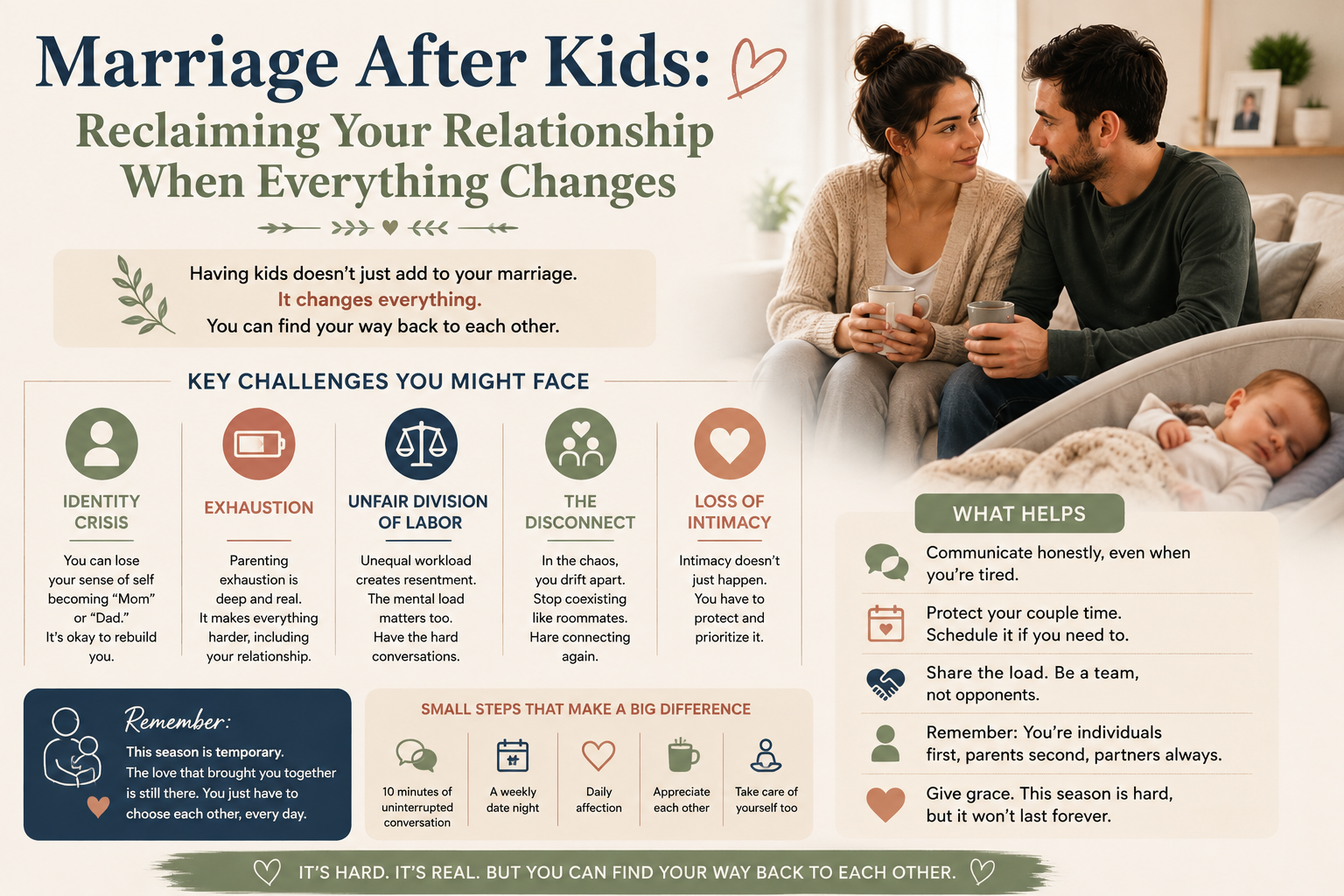
💭 The first truth: A baby doesn't just get added to your marriage — it rearranges everything. You're not a couple anymore, you're parents. That shift is disorienting, and that's normal.
The Identity Shift Nobody Warns You About
There's an identity thing that hits harder than I expected. Before Mira, I had a whole self outside of being someone's mother — a job, actual hobbies, friends I saw more than twice a year. After, for a while, I was just "Mom," full stop, and that flattening is intense for mothers especially, given the whole business of carrying the baby and birthing the baby and your hormones doing whatever they want for months afterward. Dads go through their own version — the pressure to provide, the sudden loss of freedom, realizing you're not the center of your own life anymore either. And when you lose track of who you are individually, the "us" part of the relationship takes the hit too, because it's hard to show up as a partner when you can't quite locate yourself. Nobody warns you that you'll eventually have to go looking for pieces of your old self on purpose. It's fine to grieve that old life a little. It's also fine, eventually, to grow into whoever you're becoming now — someone who adores her kid and still wants things for herself.

The Exhaustion That Gets Into Your Bones
Then there's the exhaustion, which is nothing like regular tired. It's a kind of depletion that gets into your bones. Communication gets harder. Patience just evaporates. Something that never would have bothered you six months earlier turns into a full-blown argument, seemingly out of nowhere. This exhaustion is intimacy's worst enemy — not because the love's gone, but because there's genuinely nothing left in the tank most nights. You're touched out physically, empty emotionally, running on fumes mentally, and somehow you're still supposed to show up warm and present. It's not fair, and it's real anyway. The couples who get through this stage tend to be the ones who just say it out loud — we're both wrecked, let's go easy on each other tonight — instead of taking it out on one another. And it helps, a little, to remember it's not forever, even on the nights it genuinely feels like it might be.
The Division of Labor That Breaks Marriages
The division of labor is where I've seen marriages actually break, slowly, over years rather than in one dramatic blowup. Before kids we split things reasonably evenly. After, there's just more — appointments, school forms, the mental grocery list of everyone's needs — and someone ends up carrying most of it, usually the mother, usually without either of them fully deciding that's how it would go. Resentment builds quietly under that imbalance. You start keeping a private tally: I'm the one who's up at 2am, I'm the one who remembers the pediatrician appointments, I'm the one who never gets a full weekend off. I've had this exact fight with my husband more times than I want to admit, always dressed up as something small — the laundry, whose turn it was to do bath time — when it was really about feeling unseen. Resentment doesn't fade on its own. You have to actually say the hard thing out loud, the one you've been swallowing for months.
⚠️ The hard truth: Resentment builds quietly under an unequal division of labor. It doesn't fade on its own. You have to say the hard thing out loud — the one you've been swallowing for months.
The Drift That Happens Slowly
You drift, too, if you're not careful. It happens slowly enough that you don't notice until you're already there — real conversations get replaced by logistics, who's picking up who, whether the diapers are running low. One day you look up and realize you've turned into something closer to co-managers of a household than partners, and that drift is exactly why so many marriages fall apart in the young-kid years — not one big betrayal, just a slow accumulation of not talking. The couples who stay close tend to fight that drift on purpose, even when there's genuinely no time and the kids are screaming in the next room, by carving out five minutes to talk about literally anything else.
Sex Changes — And Nobody Talks About It Honestly
Sex changes, sometimes drastically, and almost nobody says this part honestly out loud. For a lot of mothers there's the exhaustion, the being-touched-out feeling, and frankly the fact that after a day of being covered in someone else's spit-up, intimacy is the last thing on your mind. For fathers, the flip side can feel like rejection, even when it isn't personal at all. There's the body stuff too — a C-section scar, weight that didn't come off the way you expected, a body that doesn't quite feel like yours anymore. It's genuinely hard to feel desirable after birth and months without real sleep. The couples who navigate it tend to just name it — this is different right now, and that's okay — and find smaller ways to stay physically connected while they wait for the rest to come back, which it usually does, if you let it.
❤️ Truth about intimacy: Sex changes after kids. It's normal. Name it out loud — "this is different right now" — and find smaller ways to stay connected. It usually comes back, if you let it.
Grandparents, Boundaries, and Family Patterns
Grandparents are their own chapter, honestly. Mine have been an enormous help and also, at times, a source of very specific opinions about feeding schedules I never asked for. Suddenly you're not just managing your marriage, you're managing your relationship with your parents, your husband's relationship with your parents, and his relationship with his own — and the first couple years tend to surface family patterns nobody noticed before. You need a united front even when you two disagree privately, and you need actual boundaries about what advice gets taken and what doesn't, which is a lot easier to say than to do with your own mother standing in your kitchen telling you the baby's dressed too warm.
Self-Care Vanishes — And You Have to Fight for It
Self-care basically vanishes for a while. The gym, the fifteen minutes with a book, coffee with a friend — all of it gets swallowed by nap schedules that never quite line up with your own needs. And when neither of you is taking care of yourselves, neither of you has much left to give the marriage either. The couples who make it through tend to insist on trading off — you get Saturday morning, I get Sunday — even when it feels indulgent, because a depleted parent makes a worse partner, not a more devoted one.
The Paradox at the Center
Kids are the paradox at the center of all this. They're the best thing that's ever happened to our marriage, and also the hardest thing it's ever had to survive. They give you a shared purpose deeper than almost anything else could, and they also generate real tension — over discipline, screen time, whose parenting instincts win out in the moment. The marriages that hold up are the ones where both people remember they're on the same team even mid-argument, and where the disagreements happen out loud instead of turning into silent scorekeeping, partly because the kids are absorbing exactly how the two of you treat each other, whether you mean to be teaching them anything or not.
🌟 The paradox: Kids are the best thing that ever happened to your marriage — and the hardest thing it's ever had to survive. Both are true at the same time.
Marriage Has Seasons
Marriage has seasons, is the thing I keep coming back to. The baby years are their own brutal season — often not very joyful if I'm honest, mostly survival — and then there's toddlerhood, and school age, and presumably teenage years waiting somewhere down the road with their own flavor of chaos. The trick, if there is one, is remembering it's a season and not a permanent verdict on the marriage. You might barely talk for a stretch. You might go weeks without real intimacy. That doesn't mean it's over — it means you're in a hard season, and seasons end.
And there's a genuine rediscovery on the other side, from what I've seen with friends further down this road than us. The kids get a little older, need you a little less, and you look at your partner and realize you don't fully know this version of them — the parent version, often more patient, often changed in ways you didn't watch happen in real time. You get to date again, sleep in occasionally, finish a sentence uninterrupted. It's genuinely a second beginning, built on something the two of you actually survived together.
What Actually Works
What seems to actually work, watching other couples and living through it ourselves: talking about the hard stuff instead of pretending it's fine, naming the exhaustion out loud instead of assuming your partner can read your mind, remembering you're on the same team even when you're annoyed at each other, and making time for one another even when there's technically none to make. It doesn't have to be fancy — staying up to watch one episode together counts, so does a walk while the grandparents have the kids for an hour. Scheduling intimacy sounds unromantic on paper and turns out to matter more than spontaneity ever did once you have kids.
If you're deep in it right now — running on five broken hours of sleep, crying in the car because you don't know how you'll do tomorrow again, looking at your partner and feeling like you're basically strangers who happen to share a mortgage — I want you to know it doesn't stay this hard indefinitely. It eases, unevenly, in small increments you barely notice until one day you realize you slept through the night, or had an actual hour to yourself, or left the house without the baby and didn't feel guilty the whole time.
Start small if you're trying to find your way back to each other. Say the hard thing out loud — this is genuinely hard right now, I think we're both struggling. Give yourself some grace, and give your partner some too. One real conversation not about the kids. One touch that isn't purely functional. You don't have to fix the whole thing tonight.
💍 Final thought: Marriage after kids isn't the same relationship it was before. Different bodies, different priorities, different people. The work is learning to love who they've become — and letting them do the same for you. Messy, tired, imperfect — and worth choosing again, most days.