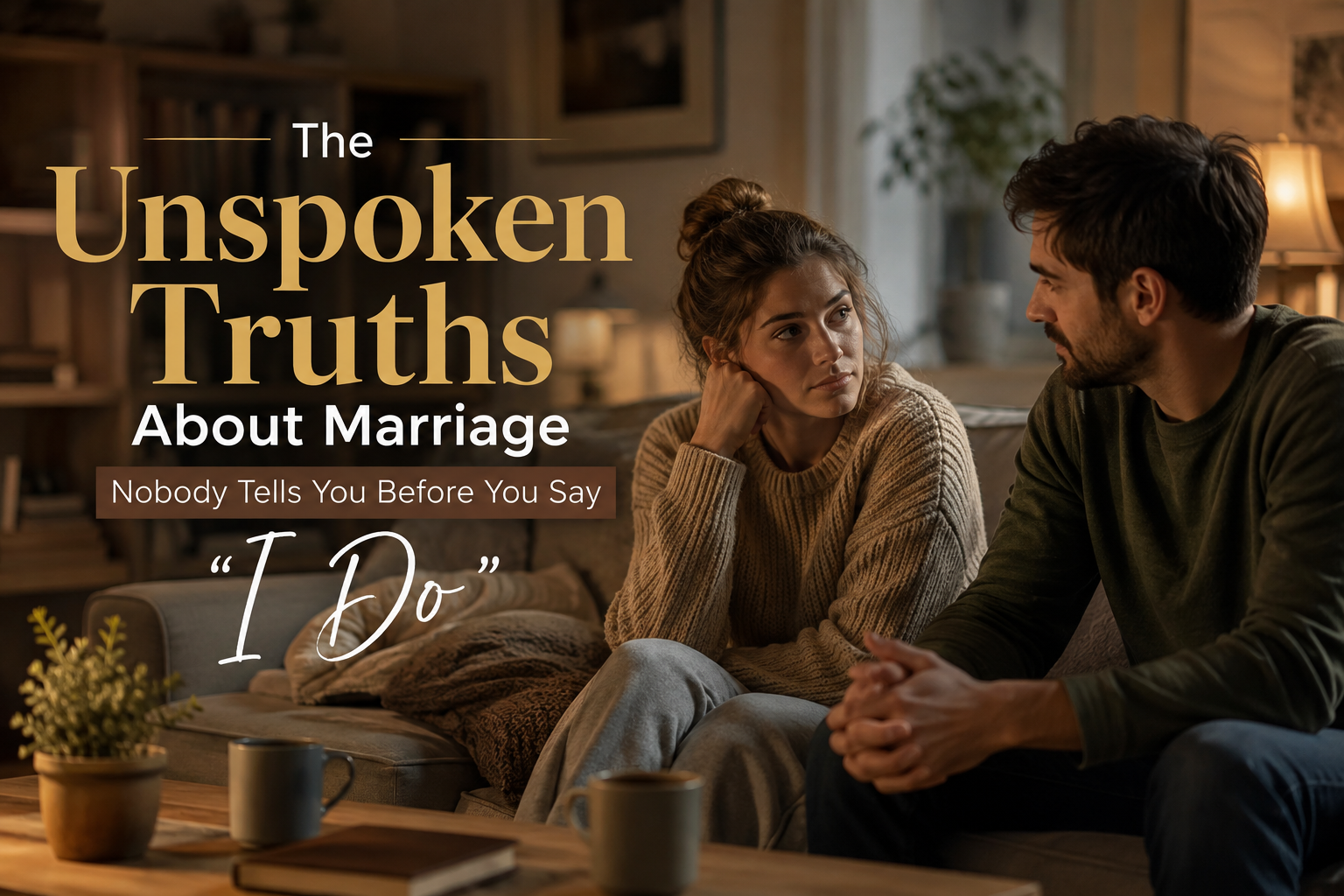
Nobody said any of this to me at my own wedding. Not in the vows, not in my sister's toast, definitely not in the eleven hundred photos our photographer took that day.
The morning after, I woke up next to Sam and had this strange, almost stupid thought: okay. Now what. We'd spent close to a year planning one afternoon, and then it was just Tuesday again — same tiny apartment on Grant Street, same crusty pan from the night before still sitting in the sink because neither of us had bothered. There was a piece of paper filed somewhere now that supposedly made us different people. It didn't, not really, not that fast.
That's more or less the first thing nobody warns you about. A wedding is one day. A marriage is thousands of days lined up back to back, and most of them look almost identical to the days you had before, minus the flowers.
💭 The first truth: A wedding is one day. A marriage is thousands of ordinary Tuesdays stacked together. The flowers fade, but the real work begins the morning after.
On Feelings Fading
It took me way longer than it should have to actually believe this, but love isn't really a feeling — it's closer to a decision you keep re-making. When you're newly dating someone, it feels like a current pulling you along, and you don't have much say in it. Checking your phone every ten minutes. Not sleeping right. That part is fun, and it's also mostly chemistry, and chemistry runs out. It's not a sign you married wrong. It's just biology doing its thing. What replaces it, if you let it, is quieter and honestly better, but nobody hands it to you — you have to keep choosing it, some days more than once.
I found out things about myself in that first year I genuinely didn't know were there, and not all of it was flattering. Around month seven or eight I realized I was stubborn in a way I'd never had to confront before — not casually stubborn, but the kind that digs in over something dumb and won't budge even after I already know I'm wrong. Before I got married I would've described myself as easygoing, low-maintenance, a peacemaker even. Turns out that was only true when I didn't have to share a kitchen and a calendar and every single decision with another adult, all day, every day.
Sam discovered he has a temper, a small one — a cabinet left open, a dish that didn't make it to the sink, that kind of thing that never bothered him back when he lived alone. We learned this stuff through actual fights, not gentle conversations. There were a few nights I genuinely thought, who is this person, what happened to the guy I dated.
Marriage works like a mirror that way. It shows you the good in yourself pretty clearly, and it also shows you the parts you'd rather not look at directly. The upside, if there is one, is that you can't fix what you can't see, and now you can see it.
The Work Nobody Photographs
Then there's the work nobody photographs. Biting your tongue on a comment that would feel amazing to say and terrible five minutes later. Noticing that your partner's had a bad day before they say a word about it. Giving up the thing you wanted because what they needed mattered more right then, even though the middle ground felt unsatisfying to you specifically. None of this ends up on anyone's feed. Nobody's writing an article about the time you let him have the last slice even though you'd been thinking about it all day. But that boring, invisible stuff is basically the whole job.
I want to talk about the loneliness too, because this genuinely surprised me. I assumed marriage meant I'd never be alone in the way I used to be — someone in the house, someone to talk to, always. That part's true. But you can be in the same room as someone and still feel a version of alone that's hard to explain to them, because it's not really about them. Some things you carry are just yours, no matter how close another person gets. It's not a red flag. It's not evidence the relationship is failing. It's just what it is to be a whole separate person married to another whole separate person. Marriage doesn't erase that — it just gives you company inside it, which turns out to matter more than I expected.
Kids Change Everything
Kids change everything, and there's no version of this where they don't. Before we had our son, my husband and I were each other's main thing. After, we became co-parents first and partners second, at least for a stretch, and that's a completely different job than the one we signed up for. Nobody tells you how deliberately you'll have to protect the marriage part once there's a baby who needs you every three hours. You get touched out. Exhausted in a way sleep doesn't fully fix. By the time he's finally down for the night you don't have much left, so you end up on your phone instead of talking, and you tell yourself it's temporary. Sometimes it is. Sometimes the gap just keeps growing until you look up two years later and realize you two have started to feel like roommates who share a mortgage. Getting back from that spot takes actually saying it out loud — we need to see each other again — and then following through on it even when you're tired, which is basically always.
👶 Truth about kids: You become co-parents first and partners second. Protecting your marriage takes deliberate effort — it won't happen on its own.
Money, Sex, and Everything Else
Money deserves its own section because it wrecks more marriages than almost anything else, and it's rarely actually about the money. You're not just combining two bank accounts, you're combining two entire philosophies about what money means — safety, freedom, control, whatever it is for each of you — and those philosophies don't always get along. Couples who handle it well aren't necessarily the ones with more money. They're the ones who talk about it regularly instead of only during a crisis, no secret purchases, no hidden statements, working toward things together instead of separately. The couples who struggle usually aren't struggling with arithmetic. They're struggling with shame, or fear, or the need to feel in control of something, and the dollar figure is just where that argument happens to land.
Sex changes too, and almost nobody talks about it honestly. The can't-keep-your-hands-off-each-other stretch is real and it's great and it doesn't last forever, not because something's wrong but because life gets in the way — work, stress, a sick kid, plain exhaustion. It gets more scheduled. Sometimes, if you're honest, a little bit obligatory. That's normal, apparently — most long marriages hit this. The ones that come out fine are the ones where people talk about it instead of pretending nothing's changed.
I Hated My Husband Once
I hated my husband once. I don't love admitting that, but it's true, for close to a year. I hated the way he chewed. I hated how he left cabinet doors open. I hated that he could dismiss something I said without even registering he'd done it. Some of that was really about feeling unseen, not about the cabinets at all, though it took me a while to admit that even to myself. This was during a stretch that looked completely fine from the outside — decent jobs, healthy kid, nothing dramatic happening. I never told a single person, I was too embarrassed. But you can hate someone and still love them; those aren't opposites, they're just both true at once sometimes. The people who make it through are the ones who can sit with both feelings without bolting. That season passed for us. I don't hate him anymore. But knowing I could and still choose to stay taught me something — that commitment, not the feeling of the day, is actually what holds the thing together.
❤️ Hard truth: You can hate your spouse and still love them. Those aren't opposites — they're just both true at once sometimes. Commitment is what holds the thing together, not the feeling of the day.
Friends Drift, People Change
Friends drift, too, and this one caught me off guard more than I expected. I had a close group before the wedding — we talked constantly, saw each other most weeks. After, they were still around, technically, just less. Not because anyone disliked Sam, and not because I'd changed that dramatically. It's just that life gets busy and couples start hanging out with other couples and single friends quietly become the odd one out at dinner. My circle shrank without me ever deciding it should, and I didn't handle it well — I poured everything into the marriage instead, which meant when things got hard I had nowhere else to go, and it put weight on him that wasn't really his to carry alone. I'm still rebuilding some of those friendships. Slower than I'd like.
People change too, and not always at the same pace as their partner. You might shift your mind about kids, or faith, or where you want to live, and your partner might just... not, at least not on your timeline. You can't force someone to grow on your schedule. What you can do is leave room for it and stay connected across whatever gap opens up, which is easier to write than to actually live through.
Forgiveness in a marriage isn't a single moment you get through once. It's something you end up doing again and again for the same old wound, because trust doesn't rebuild on a schedule and healing just isn't linear, no matter what anyone tells you. The couples who last don't keep score. They let it go, repeatedly, even when every instinct says to protect yourself instead.
The Good Stuff Nobody Sees
Some of it is genuinely good, though — I don't want this to read like a complaint. At three in the morning, when the baby wouldn't stop crying and neither of us had slept properly in days, love showed up in small, unglamorous ways. Him taking the next shift so I could get two more hours. A tired "I've got this" that meant more than it should have. Nobody photographs that. It's not the vacation, it's not the big gesture — it's the ordinary Tuesday you don't remember choosing but somehow do remember, years later, more clearly than the wedding itself.
A few clichés turned out to be true, annoyingly. Marriage does take work, more than I expected and different work than I expected. Communication really is most of it, and not just the talking part — the listening part is harder and matters more. "Don't go to bed angry" is, in my experience, sometimes just bad advice; some fights genuinely need sleep before they need resolving. And the one that matters most: your spouse isn't the enemy, even on the day it feels like it. The problem is the problem. You're supposed to be on the same side of it.
🌟 The real secret: Your spouse isn't the enemy. The problem is the problem. You're supposed to be on the same side of it — even when it feels like you're not.
The Choice That Keeps Coming Back
I used to believe in soulmates, one perfect person out there somewhere. I don't anymore. I think there are probably several people any of us could've built a life with, and Sam isn't mine because of fate — he's mine because I keep choosing him and he keeps choosing me back. We're not perfect. We still argue about nothing. But we also have a whole life now, a kid, a decade of memories, and the ongoing choice to keep adding to it. That's what love actually is, as far as I can tell. Not a feeling. A choice you make so many times it starts to feel like a fact about you.
If I could tell my newlywed self one thing, it'd be this: you won't be the same person in ten years, and neither will he, and that's fine — it's kind of the point. You'll disappoint each other and surprise each other, sometimes in the same week. And every day there's a small, boring choice sitting there — to stay, to forgive, to keep showing up. Marriage is the hardest and best thing I've done, and it's also just deeply ordinary. Most Tuesdays. But all those ordinary days stacked together end up being a whole life, and nobody quite manages to say that part out loud before you sign the certificate.
💍 Final thought: Marriage isn't about finding a soulmate. It's about choosing the same person over and over again, even on the days it's hard. That's the unspoken truth nobody tells you.