The purpose of these conversations is not to find someone who agrees with everything you say. It is to understand whether two people can respect each other's values, discuss differences and make important decisions together.
During the Pakistani rishta process, families often spend considerable time discussing education, profession, family background and other details. These things can be useful, but they do not always explain what married life will actually look like.
Two people may have similar backgrounds and still hold very different expectations about money, careers, household responsibilities or living arrangements. Those differences do not automatically mean a proposal is unsuitable. What matters is whether both people can discuss them honestly before making a commitment.
This guide is designed to help prospective partners and families approach those discussions with respect. It is not a test, a guarantee of compatibility or a substitute for professional legal or counselling advice.
Your Before-Marriage Conversation Map
10 important topicsWhy these conversations deserve attention
Consider an illustrative situation. A prospective bride plans to continue her teaching career after marriage. Her prospective partner assumes that she will leave her job once they marry. Both may have sincere intentions, but neither has discussed the expectation openly.
After the wedding, the difference becomes a source of disappointment. The issue is not necessarily that one person is right and the other is wrong. The issue is that an important decision was treated as an assumption instead of a shared discussion.
Similar misunderstandings can arise around financial support for parents, household responsibilities, moving abroad, personal privacy and raising children.
A useful principle: Do not expect your future spouse to automatically understand an expectation you have never explained. Give each other the opportunity to ask questions before important decisions are made.
What research tells us about preparing for marriage
Premarital preparation has been studied by relationship researchers. The findings are useful, but they should be understood carefully rather than treated as a promise that any programme can guarantee a successful marriage.
Two important research perspectives
A study by Stanley and colleagues examined premarital education and marital outcomes. It reported associations between participation in premarital education and several positive relationship measures. However, an association does not prove that education alone caused those outcomes.
A 2010 meta-analysis by Fawcett and colleagues found that the overall effects of premarital education were more limited than some earlier claims suggested, although communication skills showed benefits. This is a helpful reminder that preparation can be useful without being a guarantee.
Another study by Carrère and Gottman examined how newly married couples began conversations about conflict. Their findings highlighted the importance of the emotional tone at the beginning of difficult discussions among the couples studied.
These studies were not designed specifically to measure Pakistani couples. Their findings should therefore be considered general relationship research, not a direct prediction of what will happen in every Pakistani marriage.
Conversation 01 Money, savings and financial responsibilities
Understand each other's financial expectations
Financial decisions can affect almost every part of married life. Couples should understand how they each think about spending, saving, debt and supporting family members.
In Pakistan, financial responsibilities may also include helping parents, contributing to household expenses or supporting siblings. These commitments should be discussed honestly rather than discovered unexpectedly.
Questions worth discussingYou do not need to disclose every private financial detail in the first meeting. But before making a serious commitment, both people should have a reasonably clear understanding of financial obligations that could affect their shared future.
Conversation 02 Family involvement and living arrangements
Discuss the home you expect to build
Marriage can bring two families closer. For many Pakistani couples, family support is an important part of life. At the same time, both partners need to understand how family involvement will influence their everyday decisions.
Questions worth discussingLiving with parents is not automatically a problem, and choosing a separate home is not automatically a better arrangement. The important thing is that both partners understand the plan and can express their preferences without pressure.
Conversation 03 Careers, education and future ambitions
Make room for each other's goals
A person's professional ambitions do not disappear after marriage. Some couples want to build careers together, while others may prefer different arrangements depending on their circumstances.
Questions worth discussingThis discussion is especially relevant to couples who may relocate between cities or countries. If your family is exploring overseas proposals, you can also learn about Pakistani matrimony in the United States and Pakistani matrimony in the United Kingdom.
These pages explain aspects of the service and are not a guarantee of a particular proposal or outcome.
Conversation 04 Conflict, anger and disagreements
Learn how each person responds under pressure
Even compatible couples can disagree. What matters is whether they can discuss problems without humiliation, intimidation or threats.
Questions worth discussingRelationship researcher John Gottman has written about communication patterns that can damage discussions, including criticism, contempt, defensiveness and stonewalling. These patterns are worth understanding because they can make a disagreement harder to resolve.
A conversation that escalates
- “You never understand anything.”
- Bringing up unrelated past mistakes
- Mocking or insulting the other person
- Refusing to discuss the issue indefinitely
A more constructive approach
- “I feel worried about this issue.”
- Discussing one problem at a time
- Listening before responding
- Agreeing when to continue the discussion
A useful way to begin is to describe what happened, explain how it affected you and make a clear request. For example: “I feel overwhelmed when we leave every household decision until the last minute. Could we plan these things together?”
A disagreement is not the same as abuse. Threats, violence, intimidation, coercive control or fear should not be treated as ordinary communication problems. In such circumstances, personal safety and independent professional support should come first.
Conversation 05 Children, parenting and family planning
Understand what parenthood means to each person
Couples may have different expectations about having children, timing, childcare and parenting responsibilities. These subjects deserve a thoughtful conversation before marriage.
Questions worth discussingIt is also important to discuss how both partners would respond if their plans changed because of health, finances or personal circumstances. No one should feel pressured to promise an outcome that cannot be guaranteed.
Conversation 06 Faith, values and everyday practices
Discuss the values that shape your home
People can share a religious background while having different approaches to daily practice. It is helpful to understand what faith, traditions and values mean to each person.
Questions worth discussingThe purpose is not to judge someone else's level of religious practice. It is to understand whether both people can respect each other's beliefs and make thoughtful decisions about their shared home.
Conversation 07 The Nikahnama and agreed marriage terms
The Nikahnama deserves careful attention. It is not simply a document to sign during a busy wedding ceremony. It records important details and agreed terms relating to the marriage.
Pakistan's Muslim Family Laws Ordinance, 1961 and the relevant rules provide the legal framework for marriage registration and the prescribed Nikahnama form. The official Pakistan Code provides access to the relevant rules and form.
Nikahnama: A practical reading checklist
- Haq Mehr: Understand the agreed dower, its amount or property details, and the agreed payment arrangement.
- Relevant columns: Read the entries relating to dower and make sure they accurately reflect the agreement.
- Special conditions: Discuss any proposed conditions and understand their legal meaning before signing.
- Delegated right of divorce: Understand whether any related provision is included and what it means.
- Copies and records: Ask how the completed document will be authenticated and how each party will receive the relevant record.
In September 2026, reporting on a Supreme Court decision described directions requiring Nikah registrars to complete relevant entries carefully and accurately. The reporting also highlighted the importance of clearly recording dower terms and explaining relevant entries before signatures or thumb impressions are taken.
You can read Dawn's coverage of the Supreme Court decision on dower and Nikahnama entries and consult the official Pakistan Code rules and prescribed Nikahnama form .
Important: Do not sign a document containing entries you do not understand. Ask the registrar to explain unclear details. For complicated terms or legal concerns, consult a qualified family lawyer before signing.
Conversation 08 Health, wellbeing and important information
Approach sensitive subjects with care
Health can affect daily routines, future plans and shared responsibilities. Both people should have the opportunity to discuss important information that may affect married life.
Questions worth discussingThese conversations should be respectful and private. No one should be pressured to disclose sensitive details to an entire family or wider social circle. Where a medical question matters to a future decision, a qualified healthcare professional can help explain it.
Conversation 09 Friends, digital privacy and personal boundaries
Agree on what privacy means to both of you
A healthy relationship does not require one person to give up every form of personal space. Couples should discuss how they feel about phones, social media, friendships and private communication.
Questions worth discussingTrust should not be built through surveillance, forced access to accounts or controlling behaviour. Discuss boundaries that both people can accept freely.
Privacy also matters when families share personal information with a matchmaking service. Before submitting photographs or personal details, read MatchFusion Matrimony's privacy policy to understand the information provided on the website.
Conversation 10 Emotional needs, affection and everyday care
Understand how each person experiences care
People express affection in different ways. One person may value time together, while another may feel supported through practical help, thoughtful words or small acts of kindness.
Questions worth discussingThese questions may seem simple, but they can reveal how each person understands affection and support. A relationship is shaped not only by major decisions but also by the everyday ways people treat one another.
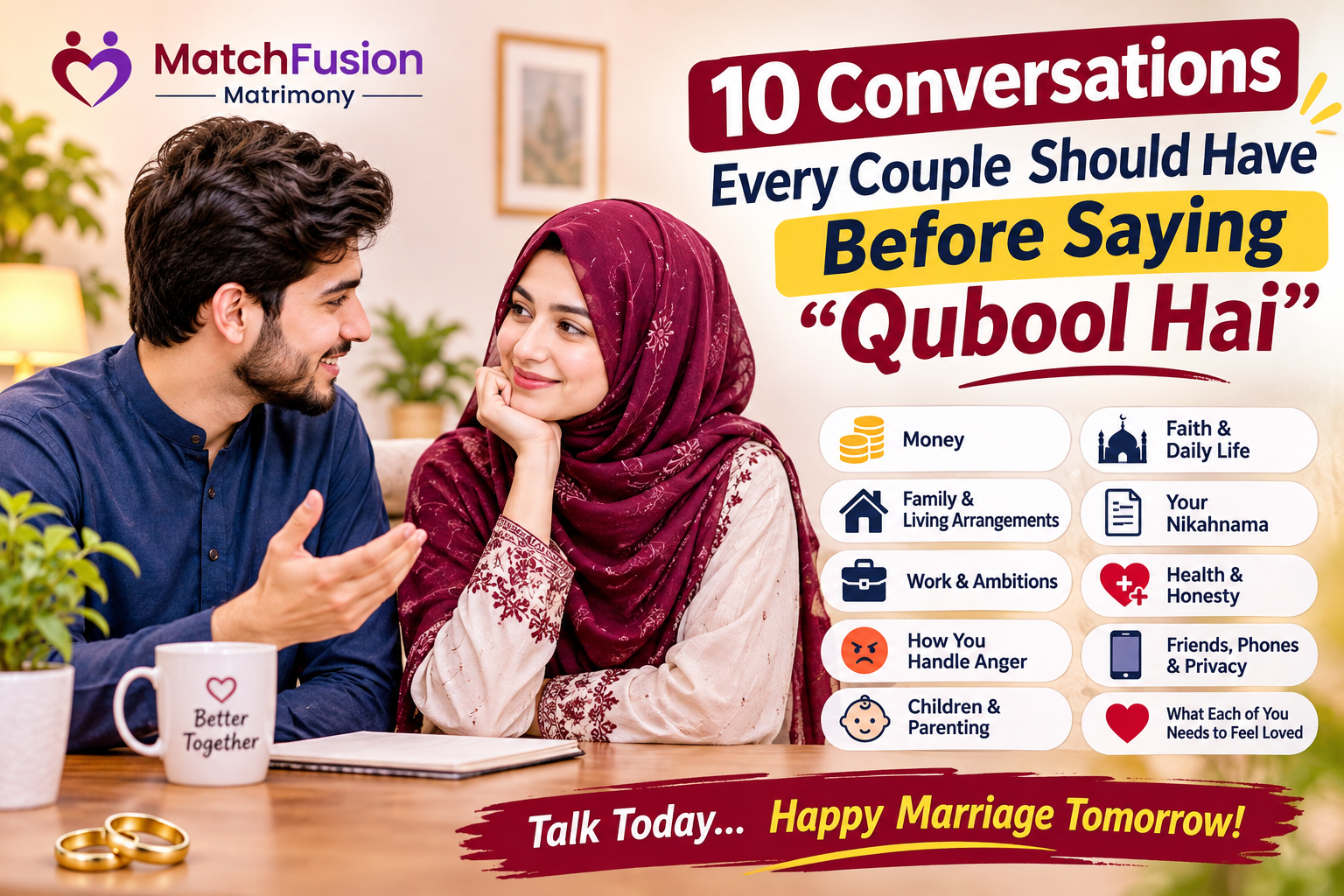
How to understand the differences between you
After discussing these subjects, you may discover that you agree on some matters and have different opinions about others. That is not necessarily a problem. What matters is understanding which differences can be discussed and which issues require more serious consideration.
A simple compatibility reflection
Use these categories as prompts for discussion—not as a score, ranking or scientific compatibility test.
Illustrative visual only. The highlighted segments do not represent real survey results or an assessment of any couple.
Instead of asking whether you agree on every subject, ask whether you can discuss differences respectfully. Some decisions may need more time, more information or advice from a suitable professional.
A practical way to begin these conversations
Trying to discuss ten major topics in one meeting can feel overwhelming. A more comfortable approach is to give each subject its own time and let both people speak.
A simple discussion plan
Choose one subject.
Start with a topic that both people feel comfortable discussing.
Ask open questions.
Give each person enough time to explain their expectations.
Listen without rushing.
Avoid treating a different opinion as an immediate rejection.
Identify important differences.
Separate minor preferences from decisions that could affect daily life.
Return to unresolved subjects.
Do not feel pressured to settle every question in one meeting.
Seek suitable guidance when needed.
A qualified counsellor or lawyer may help with specific concerns.
If a conversation reveals a serious disagreement, take time to understand it. It is better to pause a decision than to enter marriage believing that an unresolved issue will automatically disappear.
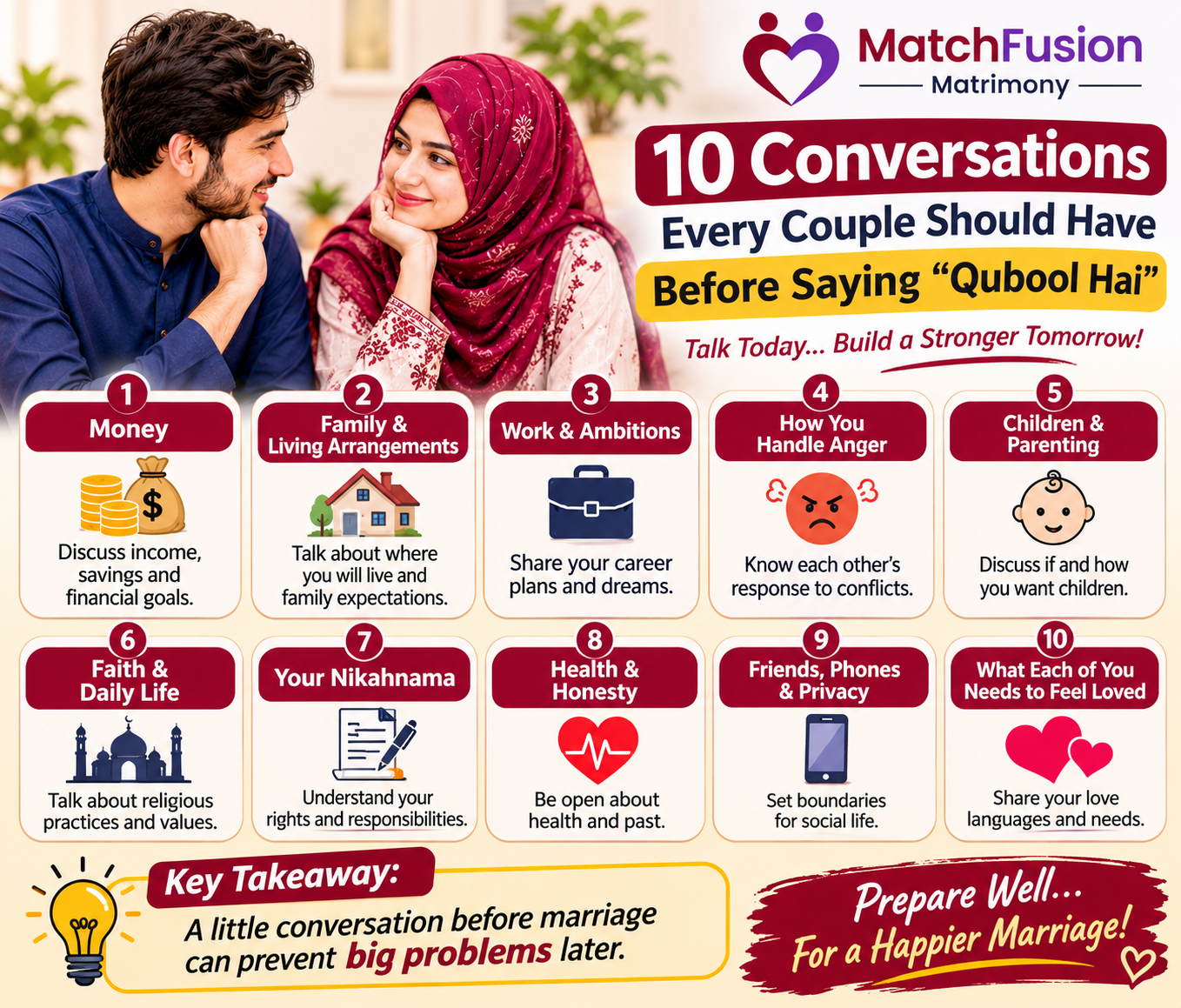
A thoughtful beginning matters
No list can predict exactly how a marriage will develop. People change, circumstances evolve and unexpected challenges can arise. But couples can give themselves a better opportunity to understand one another by discussing important subjects before making a lifelong commitment.
The goal is not to find a perfect person or a partner who agrees with every preference. It is to understand whether both people can communicate honestly, respect boundaries, share responsibilities and approach important decisions as a team.
A meaningful conversation before marriage may not answer every question. It can, however, help both people make a more informed decision about the future they are considering.
Exploring Your Rishta Journey?
MatchFusion Matrimony provides information about matchmaking for families in Faisalabad, across Pakistan and overseas. If you would like to learn more about the service or ask a question, contact our team.
Frequently Asked Questions
Is it rude to ask serious questions during the rishta process?
No. When both families are seriously considering a proposal, respectful conversations about expectations, finances, family and future plans can help both people make an informed decision. Choose an appropriate time and allow both people to speak freely.
What should couples discuss before marriage?
Couples can discuss finances, family involvement, living arrangements, careers, conflict, children, faith, the Nikahnama, health, privacy and emotional expectations. The subjects that matter most may differ from one couple to another.
What if we disagree on an important subject?
Take time to understand the difference. Some disagreements can be resolved through discussion, while others may reveal different long-term expectations. Neither person should feel pressured to ignore a serious concern.
Does premarital counselling help?
Premarital counselling can provide a structured setting to discuss expectations and communication. It may be helpful for some couples, but it cannot guarantee a successful marriage.
Should both people read the Nikahnama before signing?
Both parties should read and understand the relevant entries and agreed terms before signing. If any provision is unclear, ask for an explanation and seek appropriate legal advice where necessary.
Should every conversation happen before the engagement?
There is no single timetable for every family. Important discussions should take place at an appropriate stage before a final marriage commitment, with enough time for both people to consider the answers.
References and Further Reading
The following publications and legal resources provide additional information related to the subjects discussed in this article.
- Stanley, S. M., Amato, P. R., Johnson, C. A., & Markman, H. J. (2006). Premarital education, marital quality, and marital stability. Journal of Family Psychology, 20(1), 117–126. View research record .
- Fawcett, E. B., Hawkins, A. J., Blanchard, V. L., & Carroll, J. S. (2010). Do Premarital Education Programs Really Work? A Meta-Analytic Study. Family Relations, 59(3), 232–239. View publisher record .
- Carrère, S., & Gottman, J. M. (1999). Predicting Divorce among Newlyweds from the First Three Minutes of a Marital Conflict Discussion. Family Process, 38(3), 293–301. View DOI record .
- The Gottman Institute. How to Fight Smarter: Soften Your Start-Up .
- Pakistan Code, Ministry of Law and Justice. West Pakistan Rules under the Muslim Family Laws Ordinance, 1961 .
- Dawn, September 23, 2026. Dower is wife's right, not a bargaining chip, SC rules .
Editorial note: This article provides general educational information. It does not replace personalised legal, medical or counselling advice. Legal requirements and procedures should be checked against the applicable current law.