NCCIA and Online Rishta Fraud in Pakistan: How to Report Cyber Crime
Introduction: When a Search for Marriage Turns into an Online Scam
For many people in Pakistan, the internet has made the search for a suitable marriage partner more accessible. Matrimonial websites, social media platforms, messaging applications, and online matchmaking services allow individuals and families to connect beyond geographical boundaries.
However, the same digital convenience can also be misused.
A person may create a fake marriage profile, pretend to belong to a respectable family, use someone else’s photographs, request money under false circumstances, or gradually build emotional trust before attempting financial exploitation. In more serious situations, online rishta interactions can develop into blackmail, harassment, identity theft, or threats involving private photographs and conversations.
These incidents are not simply disappointing matchmaking experiences. Depending on the facts and evidence, certain activities may amount to cybercrime and require investigation by the relevant authorities.
In Pakistan, the National Cyber Crime Investigation Agency (NCCIA) is the designated agency for cybercrime inquiries, investigations, and prosecutions under the relevant legal framework.
This guide explains how online rishta fraud happens, what evidence victims should preserve, and how to approach NCCIA when reporting suspected cybercrime.
What Is Online Rishta Fraud?
Online rishta fraud occurs when someone uses a false identity, misleading information, deception, or digital communication to exploit a person who is seeking a marriage proposal.
The intention may be financial gain, access to private information, emotional manipulation, harassment, or another form of exploitation.
Not every unsuccessful proposal or disagreement is fraud. A person changing their mind, declining a proposal, or ending communication does not automatically constitute a cybercrime. The nature of the conduct, the intention behind it, and the available evidence matter.
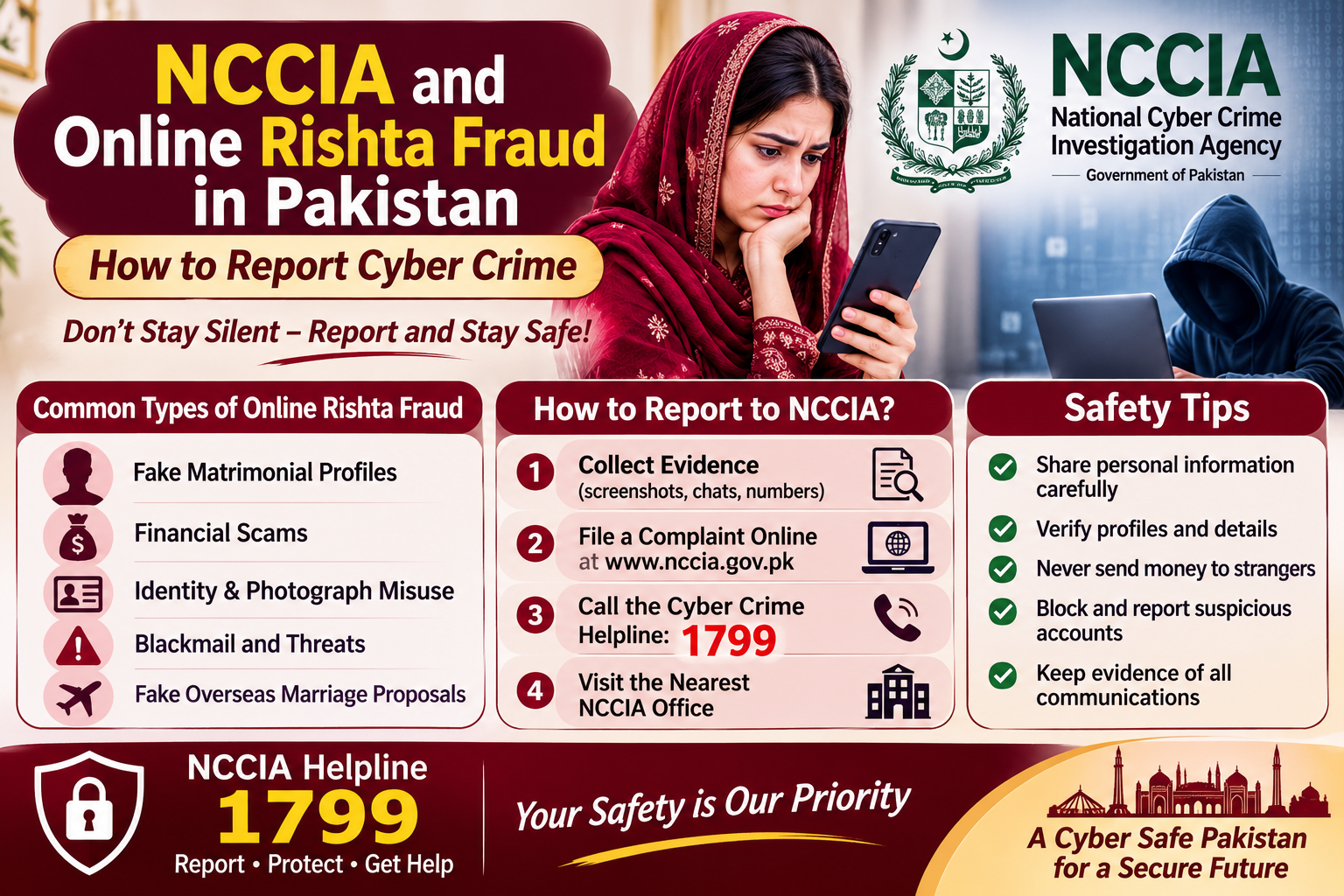
Common Types of Online Marriage Scams in Pakistan
1. Fake Matrimonial Profiles. A scammer may use another person’s photographs, a false name, an invented occupation, or fabricated family details to appear suitable for marriage. The profile may be designed to attract trust before the person requests money or private information.
2. Marriage-Related Financial Scams. Some individuals create urgent stories involving travel expenses, medical emergencies, visa processing, family difficulties, or wedding arrangements to persuade someone to transfer money. A financial request should always be independently verified, especially when the relationship exists entirely online.
3. Identity and Photograph Misuse. Using another person’s photographs or personal information without permission can create serious privacy and reputational concerns. If the material is used for impersonation, deception, threats, or harassment, preserve the relevant evidence and seek guidance from the appropriate authority.
4. Blackmail and Threats. A person may threaten to publish private conversations, photographs, videos, or personal information unless the victim sends money or follows certain demands. Do not assume that paying will stop the threats. Preserve the evidence and report the incident.
5. Fake Overseas Marriage Proposals. Some scammers claim to live abroad or promise marriage in another country. They may use fabricated employment information, false travel documents, or invented visa-related expenses to gain credibility. An overseas proposal should be verified independently rather than accepted on the basis of photographs or online claims. Our guide on visa, residency and paper marriage scams covers this in more detail.
When Should You Report an Online Rishta Scam to NCCIA?
You should consider contacting NCCIA when an online interaction involves suspected criminal activity, such as:
- A person deliberately impersonating someone else through a digital account.
- Fraudulent demands for money supported by deception.
- Threats to publish private photographs or conversations.
- Online harassment, intimidation, or blackmail.
- Unauthorized access to an account or misuse of digital information.
- Fake accounts being used to deceive, threaten, or exploit people.
- Other suspicious digital conduct that may fall within Pakistan’s cybercrime laws.
The exact legal classification depends on the circumstances. NCCIA can assess the complaint and determine the appropriate investigative route.
Important: Keep a record of what happened. Avoid publicly accusing someone before the facts have been established through the appropriate process.
How to Report Online Rishta Fraud in Pakistan Through NCCIA
Pakistan’s National Cyber Crime Investigation Agency provides official channels for citizens who want to report suspected cybercrime. The following steps can help you prepare your complaint.
Step 1: Preserve All Digital Evidence
Before blocking an account or deleting a conversation, preserve the information that may help explain what happened. Useful evidence can include:
- Screenshots of the matrimonial profile.
- The profile’s username, account link, or phone number.
- WhatsApp, SMS, email, or social media conversations.
- Voice messages and relevant call records.
- Bank transfer receipts or transaction references.
- Payment account details shared by the suspected individual.
- Threatening messages or blackmail attempts.
- Dates and approximate times of important interactions.
Where possible, retain original files and complete conversations instead of relying only on cropped screenshots. Do not edit, fabricate, or alter evidence. Keep a separate backup in a secure location.
Step 2: Prepare Your Complaint Details
Write a clear account of the incident in chronological order. Explain:
- When and where the online interaction began.
- Which platform or matrimonial service was involved.
- What identity or marriage-related claims were made.
- When the suspicious activity started.
- Whether money, photographs, or personal information were requested.
- What happened after you questioned the individual.
- What evidence you have preserved.
Avoid emotional or exaggerated statements. A factual description makes it easier for the relevant authority to understand the complaint.
Step 3: Visit the Official NCCIA Complaint Portal
You can access the official complaint registration form here: NCCIA Official Complaint Portal.
The portal requests information including:
- Full name.
- CNIC number.
- Mobile number.
- Email address, where applicable.
- Occupation.
- Postal address.
- City.
- Incident details and description of the suspected crime.
- Security code and confirmation of the information provided.
Complete the form carefully and provide accurate information. The official form specifies that the crime description must contain at least 25 characters.
Only use the official government website. Be cautious of unofficial websites or individuals claiming that they can guarantee a successful cybercrime complaint.
Step 4: Understand the In-Person Verification Requirement
An important detail should not be overlooked. NCCIA’s official FAQ lists several ways to report cybercrime, including its online complaint form, email, Pakistan Citizen Portal, and a visit to a Cybercrime Reporting Centre.
However, the same FAQ states that, under the procedure it references, a complainant may need to visit a Cybercrime Reporting Centre in person for verification.
Therefore, submitting an online form should not automatically be treated as confirmation that every verification or investigation requirement has been completed. For a formal complaint, contact NCCIA or visit the nearest centre and confirm the current requirements for your particular case.
Step 5: Keep Your Complaint Reference Number
If your complaint is registered through the official portal, save the reference number and any acknowledgement or receipt provided. Keep copies of:
- Your submitted complaint.
- The complaint reference number.
- Supporting evidence.
- Any communication received from NCCIA.
- Notes of follow-up conversations.
The official portal instructs complainants to quote their reference number when contacting the helpline for follow-up.
NCCIA Helpline and Official Complaint Channels
The following are the official reporting routes published by NCCIA.
| Reporting channel | Purpose |
|---|---|
| Online complaint portal | Submit a cybercrime complaint |
| Helpline 1799 | Contact NCCIA for assistance and follow-up |
| Official email | Send complaint-related information |
| Cybercrime Reporting Centre | Seek in-person assistance and verification |
| Pakistan Citizen Portal | Submit a complaint through the government platform |
Official links:
- NCCIA Complaint Portal
- NCCIA Official Website
- NCCIA FAQs
- NCCIA Office Locations
- Pakistan Citizen Portal
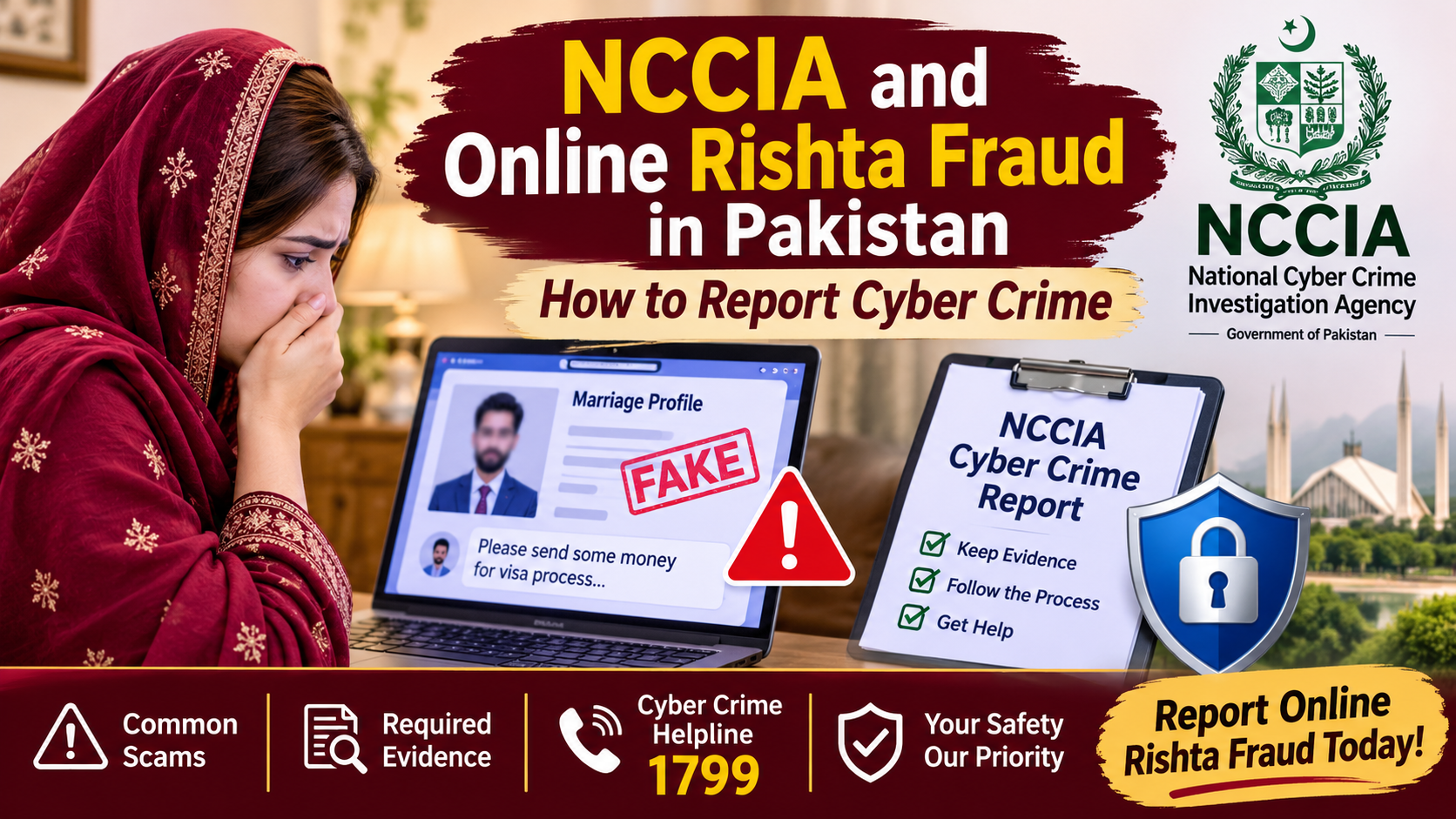
NCCIA Helpline: 1799. NCCIA’s official complaint portal identifies 1799 as its 24/7 helpline. Check the official website for current contact information and office details before visiting.
What Documents Should You Take to an NCCIA Office?
If you are asked to visit a Cybercrime Reporting Centre, prepare the documents and evidence that may help explain your complaint. According to NCCIA’s published FAQ, the basic documents include:
- A written application containing your name, address, city, and contact details.
- A copy of your CNIC.
- Copies of relevant evidence.
Depending on the incident, you may also organize:
- Screenshots and account links.
- Phone numbers and email addresses involved.
- Payment receipts and transaction references.
- Relevant conversation records.
- A short chronological summary of events.
Carry copies and retain your original records safely. Ask the relevant office whether any additional documents are required for your particular complaint.
What If You Are a Victim of Rishta Blackmail?
Blackmail can be particularly distressing because the person responsible may exploit fear, embarrassment, family pressure, or concern about social reputation. A victim may feel that staying silent is the only way to protect their privacy. However, silence does not guarantee that the threats will stop. Consider these precautions:
- Do not rush to pay. Sending money may not end the blackmail and could lead to further demands.
- Preserve the threats. Save messages, account details, payment demands, and other relevant evidence.
- Secure your accounts. Change compromised passwords, enable two-factor authentication, and review active login sessions.
- Avoid retaliatory threats. Do not attempt to hack, threaten, or publicly expose the suspected person.
- Seek appropriate support. Contact NCCIA for cybercrime reporting guidance and consider speaking with a qualified legal professional if the matter involves serious threats or privacy concerns.
If you face an immediate physical threat, contact local law enforcement or emergency services as appropriate. Do not wait for an online complaint process to address an urgent physical danger.
How Can Families Identify a Fake Rishta Profile Before It Becomes a Problem?
Prevention begins with careful verification. A convincing profile is not necessarily a genuine one, and a well-written marriage proposal should never replace independent checks. Our practical checklist for verifying a rishta can help, and these principles are a good starting point.
Verify Identity Carefully
Confirm basic identity and family information through appropriate, independent means. Do not rely entirely on photographs, social media biographies, or claims made during messaging conversations.
Be Careful With Financial Requests
Avoid transferring money to someone whose identity and circumstances have not been independently verified. Requests involving urgent travel costs, visa fees, medical bills, or wedding arrangements deserve particular caution.
Protect Personal Documents
Do not casually share CNIC photographs, passport scans, financial information, passwords, verification codes, or sensitive family documents. Only share necessary information through trusted channels and when there is a legitimate reason.
Keep Communication Respectful and Transparent
Healthy matchmaking allows both individuals and families to ask reasonable questions, verify information, and take time before making decisions. Pressure, secrecy, threats, and repeated demands for money should never be treated as normal steps in a marriage process.
Choose Matrimonial Platforms Carefully
A responsible matrimonial platform should encourage genuine information, respectful communication, privacy awareness, and safe matchmaking practices. However, using a matrimonial website does not remove the need for personal verification. Users should remain careful even when a profile appears professional or convincing.
The Difference Between a Failed Proposal and Cybercrime
This distinction is important because not every negative experience in matchmaking should be described as fraud.
| Situation | How to approach it |
|---|---|
| Someone declines a marriage proposal | Usually a personal decision, not automatically a cybercrime |
| A person stops replying | Not automatically criminal conduct |
| Someone uses a fake identity to obtain money | Preserve evidence and consider reporting suspected fraud |
| Someone threatens to publish private material | Preserve evidence and report the threats |
| Someone accesses an account without permission | Secure the account and report the suspected unauthorized access |
| Someone repeatedly harasses or intimidates you online | Preserve records and seek guidance from the relevant authority |
The legal outcome depends on the facts, applicable law, and evidence. A qualified legal professional can advise on individual circumstances.
How MatchFusion Matrimony Encourages Safer Matchmaking
At MatchFusion Matrimony, the purpose of matrimonial information should go beyond helping people find potential partners. It should also encourage informed decisions, respectful communication, and awareness of the risks associated with online interactions.
Marriage is a significant personal and family decision. Trust should develop through consistent behaviour, honest communication, and appropriate verification, not through pressure or emotional manipulation.
People using online matchmaking services should take time to understand a potential partner’s background, discuss important expectations, and involve trusted family members when appropriate.
For further reading, explore our guide on the expectations every couple should discuss before marriage. Open conversations about responsibility, family boundaries, finances, and personal values can help people approach marriage with greater clarity.
A safer matchmaking experience is built through awareness and responsible decisions. No online platform can guarantee that every person is genuine, which is why individual caution remains essential.
Frequently Asked Questions About NCCIA and Online Rishta Fraud
1. Where can I report online rishta fraud in Pakistan?
You can report suspected cybercrime through the official NCCIA complaint portal at complaint.nccia.gov.pk. You can also contact NCCIA through its helpline, official email, or a Cybercrime Reporting Centre. Check its current FAQ for reporting and verification requirements.
2. What is the NCCIA cybercrime helpline number?
NCCIA’s official complaint portal lists 1799 as its 24/7 helpline. Use the official NCCIA website to verify contact details if you need additional assistance.
3. Can I report a fake matrimonial profile?
You can report a fake profile when it is connected with suspected criminal conduct, such as impersonation, financial deception, harassment, or blackmail. Preserve the profile link, screenshots, messages, and other relevant evidence.
4. What evidence is needed for an online marriage fraud complaint?
Useful evidence may include screenshots, profile links, phone numbers, messages, emails, transaction receipts, and a written timeline. NCCIA’s published FAQ identifies a written application, CNIC copy, and evidence copies as basic documents for complaint registration.
5. Can I submit an NCCIA complaint online?
Yes. NCCIA provides an online complaint registration portal. However, its FAQ also describes an in-person verification requirement for complainants. Confirm the current procedure with NCCIA rather than assuming an online submission completes every formal requirement.
6. What should I do if someone threatens to leak my private photographs?
Preserve the threats and account information, avoid paying under pressure, secure your accounts, and report the suspected blackmail to NCCIA. If you face immediate physical danger, seek urgent assistance from local authorities.
7. Can overseas Pakistanis report online rishta fraud?
NCCIA’s FAQ says overseas Pakistanis should nominate a focal person, such as a relative or legal counsel residing in Pakistan, to pursue the matter at a Cybercrime Reporting Centre. It also mentions contacting INTERPOL or the relevant Pakistan High Commission or Embassy where no focal person is available. Confirm the current procedure with the relevant authority.
8. Is every fake marriage promise a cybercrime?
No. A broken promise, rejected proposal, or personal disagreement is not automatically a cybercrime. The conduct may require investigation when it involves activities such as digital impersonation, fraud, blackmail, threats, or other offences under applicable law.
Conclusion: Awareness Is an Important Part of Online Marriage Safety
Online matchmaking can create valuable opportunities for people and families, but digital trust should never replace careful judgment.
Fake profiles, financial deception, impersonation, harassment, and blackmail can turn a search for marriage into a distressing experience. Knowing how to preserve evidence and where to report suspected cybercrime can help victims take informed steps instead of responding through fear or pressure.
In Pakistan, NCCIA provides official channels for reporting cybercrime, including its complaint portal, helpline 1799, email, and Cybercrime Reporting Centres. Always verify the latest procedure through official sources and provide accurate information when submitting a complaint.
At MatchFusion Matrimony, we believe that a meaningful marriage journey should be supported by honesty, awareness, mutual respect, and responsible decisions. A little caution before trusting someone online can help protect much more than personal information. It can protect peace of mind, dignity, and family confidence.
Official Sources and Further Reading
Looking for a Safe, Serious Rishta?
Talk to MatchFusion Matrimony about verified, family-focused matchmaking.
Chat on WhatsAppEditorial Note: This article is intended for general public awareness and informational purposes. It is not a substitute for legal advice. Reporting procedures and official contact details may change; readers should confirm the latest information directly with NCCIA.